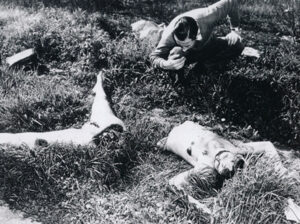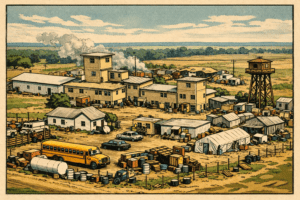
A warning before this article. The Ed Gein case involves the desecration of human remains, the use of human bodies to make objects and clothing, and the murders of two women. The physical evidence recovered from his farmhouse in November 1957 is among the most disturbing material in the history of American policing. This article describes what was found in plain but restrained terms, because to write about Gein without acknowledging what was actually in the house is to misrepresent the case. Readers who would prefer not to engage with the material should stop here.
Part One: The House Outside Plainfield
Plainfield, Wisconsin, in November 1957 was a town of approximately 680 people in the sandy, scrubby pine country of Waushara County, about 150 miles north-west of Milwaukee. It was the kind of small American farming community that the post-war years had been steadily emptying — the young people leaving for jobs in the cities, the older generation holding on through declining harvests, the main street businesses dwindling year by year. There was a hardware store, a tavern, a grocer, two churches, an elementary school, a few hundred wood-framed houses set on lots of varying tidiness, and beyond the town limits the great quiet sweep of central Wisconsin farmland in late autumn.
Six miles west of the town, on a 195-acre farm that had stopped being farmed in any meaningful sense more than a decade earlier, lived a fifty-one-year-old bachelor named Edward Theodore Gein. He lived alone in a rambling, deteriorating clapboard farmhouse with no electricity in most of the rooms, no running water, and a roof that was beginning to fail. He supported himself with handyman work — fixing fences, doing odd jobs for neighbours, babysitting children, helping at the local hardware store from time to time. He was known in Plainfield as Eddie. He was short, slight, with a lopsided smile and a tendency to giggle nervously at the end of his sentences. He was, by every contemporary account from those who knew him, harmless and a little odd. Mothers in the town occasionally left their small children in his care without thinking twice. He was the kind of man who, in a community as small as Plainfield, registered as part of the local furniture — there, mostly invisible, harming no-one anyone could see.
That assessment ended on the afternoon of Saturday 16 November 1957. By the small hours of Sunday 17 November, the Wisconsin State Crime Laboratory was inventorying the contents of Gein’s farmhouse and producing a list of physical evidence that would, over the following days, send the case onto front pages across the United States and would, over the following decades, shape the iconography of American horror more completely than the work of any other single criminal in the country’s history.
Part Two: Augusta
To understand what was eventually found in the farmhouse, one has to start with Augusta Gein, Ed’s mother. Almost every serious psychological assessment of the case, from the contemporary state psychiatrists in 1957 to the academic literature that has accumulated since, has put Augusta at the centre of the explanation.
Augusta Lehrke had married George Gein in 1899 in La Crosse, Wisconsin. The marriage was, by every available account, a deeply unhappy one. George was an alcoholic and an irregular wage-earner. Augusta was a domineering, profoundly religious woman of German-Lutheran extraction who had absolute and unyielding views on almost every subject — particularly, and corrosively, on sex, on women, and on the moral degeneracy she perceived as endemic in the world outside the family. She regarded her husband with open contempt. She maintained the marriage only because Lutheran doctrine forbade divorce.
The couple had two sons. Henry George Gein was born in 1901. Edward Theodore Gein was born on 27 August 1906. By the time the boys were of school age, Augusta had moved the family from La Crosse to an isolated 195-acre farm outside Plainfield, specifically to remove the boys from what she considered the moral contamination of town life. She kept them on the farm. She forbade them from making friends. She read to them from the Bible — particularly from the Book of Revelation and from the Old Testament passages on the punishment of harlots and the sins of women — for hours at a time. She told both boys, repeatedly and in language that the surviving record makes clear was specific and unrelenting, that women other than herself were instruments of the devil and that any contact with them outside the family would result in damnation.
This was the household in which Ed Gein grew up. He attended the local school but was not permitted to socialise. The teachers remembered him as a bright but profoundly isolated child who was occasionally seen to laugh at moments that suggested he was responding to something other than what was happening in the classroom. He was teased by the other children. Augusta beat him when she heard he had tried to make friends.
George Gein died of heart failure on 1 April 1940. Henry died on 16 May 1944 while the two brothers were burning marsh grass on the farm; the official cause of death was heart failure from smoke inhalation, but Henry was found face down in an area that had not been burned, with bruises on his head, and Ed had led searchers directly to the body in circumstances that some investigators have, in retrospect, considered suspicious. No charge was ever brought, and the Henry Gein death remains officially an accident, but the academic consensus is that Ed probably killed his brother — possibly because Henry had begun to criticise Augusta’s hold over the family. The motive would have been protective. Ed could not allow Augusta to be questioned.
Augusta herself died on 29 December 1945, after a series of strokes, with Ed at her bedside. He was thirty-nine years old. He had never had a romantic relationship, had never lived away from his mother, and had no living relatives closer than distant cousins. He was, on the morning of 30 December 1945, alone in the world for the first time in his life.
He responded by closing off the rooms of the house that Augusta had used — her bedroom, the parlour, the front sitting room — and leaving them, with all her belongings, exactly as she had left them at the moment of her death. They remained in that state, sealed and untouched, for the next twelve years. When police entered the house in November 1957, those rooms were the only parts of it that were clean.
Part Three: The Years in Between
What Ed Gein did between Augusta’s death in December 1945 and the murder of Mary Hogan in December 1954 has been pieced together from his own subsequent statements, from circumstantial evidence found in the farmhouse, and from the records of the small Wisconsin towns whose cemeteries he visited at night.
By his own confession in 1957, Gein had begun visiting cemeteries in the late 1940s and had eventually, on a series of nights between approximately 1947 and 1954, dug up the graves of recently buried women whose obituaries had appeared in local newspapers. He took the bodies — usually women in late middle age, who he believed bore some physical resemblance to his mother — back to the farmhouse, where he removed parts and discarded what he did not want. He claimed to have done this on roughly nine separate occasions, although the police investigation that followed his arrest eventually exhumed graves at three different cemeteries (Plainfield, Hancock, and Spiritland) and confirmed that at least two of the graves had been disturbed and the bodies removed. Estimates of the total number of bodies he took have ranged from nine to forty depending on the source; the lower end of that range is what Gein himself confessed to and is the figure most modern researchers accept.
What he did with the bodies is what made the case the case it became. He kept body parts as objects. He made things from them. By the time the police entered the farmhouse on the night of 16 November 1957, the inventory of items recovered from the property included a chair upholstered in human skin; a wastebasket made of human skin; lampshades made of human skin; bowls made from inverted human skulls; a belt made of human nipples; a corset made from a female torso skinned from shoulders to waist; leggings made from human skin; masks made from the skinned faces of women; the heads of women preserved in various states in boxes and shopping bags; female genitalia kept in shoeboxes; noses, fingernails, and lips kept in jars and saucers; and a “woman suit” — a complete assemblage of skinned female body parts, including breasts and a vulva, fitted together with leather lacings and apparently intended to be worn.
What Gein eventually told state psychiatrists was that he had wanted, on the nights when he wore the woman suit, to become his mother. He had wanted to crawl inside her skin, literally, and in doing so to be her. The pathology, when stated this plainly, is so close to the surface that it requires almost no interpretive work to understand. Augusta had been the only woman he was permitted to love, the only woman whose body was not the body of a harlot, the only person whose continued existence had made his own life bearable. When she died he had attempted, by the means available to a man with his particular combination of psychiatric disturbance and access to a rural Wisconsin cemetery, to bring her back. He could not. The materials he was working with were not Augusta. He needed materials closer to Augusta. He needed, eventually, materials that were still warm.
Part Four: Mary Hogan
On the afternoon of Wednesday 8 December 1954, Mary Hogan, the fifty-four-year-old proprietor of the Pine Grove Tavern in nearby Bancroft, Wisconsin, was alone in her tavern when a customer entered. The customer was Ed Gein. Hogan was a heavyset, dark-haired woman who ran her tavern alone, sometimes drank with her customers, and was known in the area for a forthright manner that some men found congenial and others found off-putting. She was, by Gein’s later confession, someone who resembled Augusta in certain physical respects. He had been in the Pine Grove Tavern many times before. He shot her once in the head with a .22 calibre rifle he had brought into the building. He dragged her body out of the tavern, lifted it onto a sled he had brought with him, and dragged the sled the several miles back to his farm.
The tavern was discovered late that afternoon by another customer. There was a pool of blood on the floor. The cash register was empty. Mary Hogan was missing. The Portage County Sheriff’s Department conducted what investigation the available evidence permitted. The .22 cartridge casing was recovered. The pool of blood was photographed. Without a body, without a witness, and with no obvious suspect, the case went, over the following months, into the inactive file. Mary Hogan’s tavern was eventually sold. Her family — she had no immediate next of kin in Wisconsin, but had relatives in Illinois — went without resolution for three years.
There is one famous and frequently retold anecdote from the period between the Hogan killing and Gein’s eventual arrest. Some weeks after the disappearance, a local sawmill operator named Elmo Ueeck was talking with Gein in Plainfield. Ueeck commented, in the casual way that small-town conversation handles such things, that Mary Hogan had vanished and that no-one knew what had happened to her. Gein, by Ueeck’s later account, smiled and said: “She isn’t missing. She’s down at the farm right now.” Ueeck took it as a joke. Everyone in Plainfield knew Ed Gein and the strange remarks he sometimes made. Nobody pursued it.
Part Five: Bernice Worden
Three years later, on the morning of Saturday 16 November 1957, Bernice Worden, the fifty-eight-year-old proprietor of the Worden Hardware Store on the main street of Plainfield, was alone in her shop. Her son Frank Worden, who normally helped her in the store, was out hunting deer for the weekend — it was the opening day of Wisconsin’s deer-hunting season, and most of the men of Plainfield were in the woods. Bernice had been a widow for many years. She ran the hardware store herself. She was known in town as practical, brisk, and reliable.
At approximately 8:30 that morning, Ed Gein entered the hardware store. He had been in the day before to make a small purchase and had asked Frank Worden whether he was planning to hunt the following morning. Frank had said yes. Gein had also asked, in conversation with Frank, about the price of a half-gallon of antifreeze. The antifreeze conversation became, in retrospect, the critical detail.
When Frank Worden returned to Plainfield at the end of the day’s hunting and found the hardware store closed and his mother gone, he entered the building through the back door. There was blood on the floor. The cash register was missing. The last sales slip in the receipt book was for a half-gallon of antifreeze. Frank Worden was both a son and a deputy of the Waushara County Sheriff’s Department. He had grown up in Plainfield and knew most of the men in the town. He thought immediately of Ed Gein.
Sheriff Arthur Schley, Frank Worden, and several other officers drove out to the Gein farm. The house was dark. Nobody answered when they knocked. They entered through the back porch — there was a summer kitchen attached to the rear of the building — and made their way through the cluttered interior with flashlights. What followed is one of the most documented and most discussed moments in American policing history. Sheriff Schley, moving through the porch area, walked into something that was hanging from a roof beam in the unlit space. He shone his flashlight upward. He saw Bernice Worden’s body. She had been decapitated and dressed out — eviscerated and gutted — in the manner that a deer carcass is prepared after a successful hunt. She was suspended by her ankles from the roof beam. The body had been hanging for several hours.
Schley reportedly did not speak for some minutes afterward. He recovered enough to lead the other officers through the rest of the property. They found Mrs Worden’s head in a burlap sack, the eye sockets and mouth filled with nails so that they could be hung as a decoration. They found her heart in a saucepan on the kitchen stove. They found, over the following hours, the contents of the house that this article has already described.
Ed Gein was arrested that night at the home of a neighbour where he had gone for dinner. He went without resistance. He told the arresting officers, in the calm tone that everyone who interacted with him in the following weeks would remark on, that he had been “in a daze.”
Part Six: The Investigation and the Confession
The Wisconsin State Crime Laboratory took control of the Gein farmhouse on the night of 17 November and remained there for the better part of a week. The inventory of items removed from the building eventually filled multiple boxes. The list became, over the following days, the basis for almost every newspaper account of the case across the United States. Editors competed for the most evocative way of summarising what had been found. The phrase “House of Horrors” attached itself to the Gein farmhouse within hours of the first wire reports and has been used to describe it ever since.
Gein was interrogated by Wisconsin State Crime Bureau officers over a period of approximately a week. He confessed to the killing of Bernice Worden. He confessed, after the police told him that Mary Hogan’s head had been identified among the remains in his farmhouse, to her killing as well. He admitted to the grave-robbing in extensive detail, identifying nine specific graves at three different cemeteries that he said he had opened. The state authorities, after some hesitation about the publicity implications, exhumed two of the graves Gein had identified — those of Eleanor Adams and Mabel Everson at Plainfield Cemetery — and found that both had been disturbed and that the bodies were either missing or severely damaged. The other graves were not formally exhumed, in part because the families could not be asked to face that without something close to certainty about what would be found, and in part because Gein’s confessions about the grave-robbing were considered sufficient on the existing evidence.
The contemporary state psychiatric examination of Gein produced a diagnosis of schizophrenia with severe psychotic features and what would today be called, more precisely, a profound personality disorder organised around the unresolved attachment to his mother. The forensic examiners concluded, in January 1958, that he was not competent to stand trial. He was committed to Central State Hospital in Waupun, Wisconsin, a state facility for the criminally insane.
The Worden murder trial, when it eventually took place, did so a decade later. In November 1968, after eleven years in psychiatric care, Gein was reassessed and found to be competent to stand trial for the murder of Bernice Worden. The trial was conducted by Judge Robert H. Gollmar at Wautoma. It lasted one week. Gein was found guilty of first-degree murder on 14 November 1968. He was then, in a separate phase of proceedings on 15 November, found not guilty by reason of insanity. The legal disposal was that he was returned to Central State Hospital, where he had already been confined for the previous decade and where he would remain for the rest of his life. The Mary Hogan murder was never separately tried, on the basis that no additional sentence could be imposed.
Ed Gein died at Mendota Mental Health Institute in Madison, Wisconsin, on 26 July 1984, of respiratory failure caused by lung cancer. He was seventy-seven years old. By every available account from the staff who had cared for him over the previous twenty-seven years, he had been a model patient — quiet, cooperative, attentive to other patients, occasionally given to long monologues about his mother. He was buried in Plainfield Cemetery, in an unmarked grave next to Augusta, at his own request. The original grave marker, which his caretakers had ordered, was repeatedly stolen by souvenir-hunters over the following decades; it was eventually removed from the cemetery in 2000 and is held in a museum.
Part Seven: The Farmhouse and the Fire
The Gein farmhouse, after the police completed their evidence-gathering in November 1957, became, very briefly, a place of dark pilgrimage. Tourists from across Wisconsin and from neighbouring states drove out to the farm. They parked on the road. They walked across the fields. They peered through the windows. They tried, in some cases successfully, to enter the building. By March 1958, four months after the arrest, the local authorities had decided that the situation was intolerable. They scheduled an auction for 30 March 1958, at which the Gein property and its contents would be sold.
On the night of 27 March 1958, three days before the scheduled auction, the farmhouse burned to the ground. The fire began at approximately 4:30 in the morning. By dawn the building was a smouldering ruin. No arsonist was ever identified. The Waushara County Sheriff’s Department investigated the fire and concluded that the origins were “suspicious,” but no charges were brought. When Ed Gein was told about the fire by the staff at Central State Hospital, he reportedly shrugged and said: “Just as well.”
The auction went ahead two days later, on the farmland and outbuildings rather than the destroyed house. The auctioneer sold the 195 acres, the equipment, the cars (including the Ford sedan in which Gein had transported Bernice Worden’s body), and the few salvageable items that had escaped the fire. Gein’s 1949 Ford was sold for $760 to a sideshow operator named Bunny Gibbons, who toured it through the American Midwest during the summer of 1958 as the “Ed Gein Ghoul Car,” charging admission to view it. The Wisconsin authorities, embarrassed by the spectacle, eventually intervened and the tour was shut down.
The Plainfield community itself, which had spent the months between the arrest and the fire reeling under the attention of the national press, took a kind of grim collective satisfaction in the destruction of the farmhouse. The site of the building was, over the following years, allowed to revert to forest. A traveller passing the location today would see nothing but pines.
Part Eight: The Cultural Afterlife
The most distinctive thing about the Ed Gein case, when measured against other American serial killer cases, is that the number of confirmed victims is unusually small — only two — and yet the cultural footprint of the case is unusually large. The reasons for this disproportion are worth examining.
The first reason is the timing. In 1957 American journalism was just learning how to operate at national scale on a sensational criminal case. The arrest of a man who had been making household objects from the bodies of women, on a remote Wisconsin farm, in the middle of November in a small Midwestern town, produced exactly the kind of material that the emerging national newspaper and magazine market wanted. Life magazine ran a major feature. The wire services produced daily updates for months. Local Wisconsin newspapers competed with national outlets for the most evocative possible descriptions of what had been found in the farmhouse. The case became, more rapidly than perhaps any previous American criminal case, a national story.
The second reason is the specific psychiatric profile of what Gein had been doing. The grave-robbing, the construction of objects from human bodies, the woman suit, the desire to become his mother — none of this fit any conventional category of American crime. It was something newer and stranger. The psychiatric and forensic literature of 1957 did not have the vocabulary for it. The case became, in the years immediately following, one of the founding subjects of what would eventually develop into the academic study of serial offenders.
The third reason, and the one that has made the case enduringly famous, was that it caught the attention of three of the most influential American filmmakers of the second half of the twentieth century.
The first was the novelist Robert Bloch, who lived in Weyauwega, Wisconsin, about thirty-five miles from Plainfield, at the time of Gein’s arrest. Bloch had been a horror and crime writer for some years. He read the local newspaper coverage of the Gein arrest as it unfolded. He began, in early 1958, to work on a novel that drew on the psychological core of what Gein had done — the unresolved attachment to a dead mother, the gendered violence, the rural isolation — while inventing an entirely fictional setting and plot around it. The novel, Psycho, was published in 1959. It was acquired by Alfred Hitchcock in 1960. The film adaptation, released in June 1960, became the most commercially successful film of Hitchcock’s career and one of the most influential horror films ever made. The Norman Bates character — the mild-mannered young man whose dead mother continues to exercise psychological control over him from beyond the grave — is a direct fictionalisation of the central pathology of Ed Gein. The film does not depict any of the grave-robbing or the body-objects, but its psychological structure is unmistakably Gein’s.
The second was the filmmaker Tobe Hooper, who in the early 1970s was developing what would become The Texas Chain Saw Massacre. Hooper drew explicitly on the Gein case for the film’s central family of rural cannibals living in an isolated farmhouse, and particularly for the character of Leatherface — the chainsaw-wielding killer whose face is hidden behind a mask made of human skin. The film, released in 1974, became one of the founding works of the modern American slasher genre.
The third was the novelist Thomas Harris, whose 1988 novel The Silence of the Lambs introduced the serial killer Jame Gumb, known by the FBI nickname “Buffalo Bill.” Gumb kidnaps women in order to skin them and construct, from their skins, a “woman suit” — the same phrase Gein himself had used. Harris drew on multiple real-world serial killers in constructing Gumb (Gary Heidnik for the captivity practices, Ted Bundy for some of the abduction methods, Edmund Kemper for the psychology), but the woman-suit element is unmistakably and almost literally Gein’s. The 1991 film adaptation, directed by Jonathan Demme, won five Academy Awards including Best Picture, and remains the only horror film ever to win that award.
Through these three works — Psycho, The Texas Chain Saw Massacre, and The Silence of the Lambs — Ed Gein has been more present in American popular culture than perhaps any other single criminal in the country’s history. The serial killers of greater body count are mostly known to the people who study such cases. Gein, despite having killed only two confirmed victims, has been known to almost every American who has watched a horror film in the past sixty-five years, even when those viewers have not known his name.
The case has, in the past decade, returned to direct cultural prominence with the 2025 Ryan Murphy Netflix anthology series Monster: The Ed Gein Story, the third season of Murphy’s Monster franchise after the Jeffrey Dahmer and Menendez brothers seasons. The series has been controversial — some critics have argued that it leans into the lurid material in ways that the historical case does not actually require, while others have praised its attempt to take Gein’s psychology seriously. The series has, regardless of its merits as drama, returned Gein to the centre of the cultural conversation in ways that have produced visible upticks in tourist interest in Plainfield, in publishing on the case, and in online discussion.
Part Nine: The Question of Why
What clinical understanding of Ed Gein has emerged in the seven decades since his arrest is, in some ways, less clarifying than the cultural responses to him have suggested.
The contemporary 1957 psychiatric diagnosis was schizophrenia with severe psychotic features. The diagnosis was probably correct in the broad sense — Gein did exhibit clear thought disorder, dissociative episodes, and what would now be called depersonalisation — but it was also, by the standards of modern psychiatric practice, somewhat blunt. The more precise modern framing would emphasise his profound personality disturbance, organised around an unresolved attachment to his mother, expressed through fetishistic and necrophilic behaviour, and producing eventually a psychotic decompensation in which the boundary between his fantasy life and his behaviour collapsed.
The unique element of Gein, when compared to other serial offenders, was that his violence was not primarily motivated by sadism in the conventional sense. The Bundy comparison is instructive. Bundy enjoyed killing and the control that killing gave him over his victims; the cruelty was the point. Gein, by his own statements and by the assessment of every psychiatrist who examined him, did not particularly want to kill. He wanted bodies. The murders of Mary Hogan and Bernice Worden were means to an end. The grave-robbing, which had been his preferred method for most of the previous decade, had become inadequate — partly because the bodies he was obtaining were too decomposed for the purposes he wanted them for, and partly because his psychotic identification with his mother had progressed to a point at which fresher material had become necessary. The killings were, in his strange and isolated logic, the next escalation of a project that had begun with the grave-robbing and that had been about Augusta from the beginning.
This is not to mitigate what he did. Mary Hogan and Bernice Worden are equally dead regardless of why he killed them. But the psychological structure of the case is genuinely distinct from the serial sadism of a Bundy or a Brady, and it is one of the reasons that the Gein material has resonated so persistently with filmmakers and novelists. He is, in a particular and unusual sense, the American serial killer as gothic figure rather than as predator — the strange man alone in the house with his mother’s body, building something monstrous out of his unbearable solitude. The Norman Bates figure is closer to the actual Gein than later horror cinema’s more violent reworkings of him.
Part Ten: The Names That Matter
The murdered were two women. Both were proprietors of small businesses in rural central Wisconsin. Both were in late middle age. Both were alone in their workplaces on the days they were killed.
Mary Hogan was fifty-four years old at the time of her death on 8 December 1954. She had been born in Chicago and had moved to Wisconsin in middle age. She had been married, divorced, and remarried. She ran the Pine Grove Tavern in Bancroft, Wisconsin, where she lived above the establishment in a small flat. She was, by the accounts of those who knew her, a woman of strong opinions, considerable warmth toward customers she liked, and considerable bluntness toward customers she did not. She kept a small dog. She had no immediate family in Wisconsin. Her remains, after recovery from the Gein farmhouse in November 1957, were buried in a Catholic cemetery in Chicago.
Bernice Worden was fifty-eight years old at the time of her death on 16 November 1957. She had been a widow for more than two decades; her husband Leon Worden had died young, and she had raised their son Frank largely alone. She had run the Worden Hardware Store on Main Street in Plainfield for more than thirty years. She was known in the town for her organisational competence, her early-morning openings, and her willingness to extend credit to local farmers in seasons when the cash had not yet come in. She is buried in Plainfield Cemetery, in the same small graveyard where Ed Gein himself was buried twenty-six years later.
Frank Worden, Bernice’s son, continued to serve as a deputy sheriff in Waushara County for some years after his mother’s death before eventually retiring. He gave occasional interviews about the case over the decades. He died in 1992. He maintained, in every public statement he made about his mother, that what should be remembered was that she had been a competent woman running a difficult business in a difficult era, and not the manner of her death.
The grave-robbing victims — the women whose bodies Gein took from their graves in the years between 1947 and 1954 — have been less consistently identified in the public record. The two graves that were confirmed in 1957 belonged to Eleanor Adams, who had died in 1951, and Mabel Everson, who had died in 1953. Both were residents of Plainfield. Both had been buried by their families with the expectation that their remains would rest undisturbed. Both had instead been taken to the Gein farmhouse and used for purposes that this article will not describe further. Their families, when informed in November 1957, faced a kind of second bereavement that no available cultural framework prepared them for. The other graves Gein confessed to opening were never formally exhumed, but the names he provided — including those of women he claimed to have visited multiple times over the years — are preserved in the Wisconsin State Crime Laboratory records and remain a kind of small and incomplete inventory of the harm he caused beyond the two killings for which he was charged.
A Final Note
Plainfield, Wisconsin, in 2026 is a town of approximately 850 people. The hardware store that Bernice Worden ran is gone. The Pine Grove Tavern is gone. The cemetery is still there, with Bernice Worden in it and Ed Gein in it and Augusta Gein in it, all within walking distance of one another. The site of the Gein farmhouse is reforested and unmarked; the foundations are no longer visible. Tourists occasionally arrive in Plainfield asking for directions to the property. The local residents have, over the decades, developed a polite and consistent refusal to provide them.
The case is one of the most thoroughly absorbed into American popular culture of any criminal case in the country’s history, and yet the actual man at its centre — small, soft-spoken, smiling, working as a babysitter and a handyman in the years between his mother’s death and his arrest — remains in some sense the most elusive figure in the post-war American serial killer canon. He is not Bundy, with his charm and his theatricality. He is not Gacy, with his clown costume and his public visibility. He is not Dahmer, whose case has been argued over and dramatised continuously since 1991. He is something quieter and stranger: a man who lived in an isolated farmhouse in a country whose modernity had not yet arrived to find him, alone with his mother’s death and with the materials he had begun to assemble in her place.
The horror, in his case, was domestic. It was conducted in a kitchen and a sitting room and a porch. It involved sewing and curing and preserving and arranging. The crime scene photographs from 17 November 1957 show, in image after image, an ordinary Wisconsin farmhouse interior — a stove, a table, shelves, an armchair — in which the ordinary objects have been replaced by their human equivalents. The chair upholstered in skin still has the shape of a chair. The skull bowl still has the shape of a bowl. The case has reached so deeply into American horror cinema for the past sixty-five years partly because what Gein did was, in its own awful logic, an exercise in transforming domesticity into something it should not have been able to become.
Mary Hogan ran a tavern. Bernice Worden ran a hardware store. They were ordinary women conducting ordinary businesses in ordinary American towns on the days they were killed. The fact that the man who killed them is now best remembered through fictional characters created by Robert Bloch and Tobe Hooper and Thomas Harris is the part of the case that should perhaps trouble us most. The cultural memory of Ed Gein has been more durable than the cultural memory of his victims. That is not the fault of the victims, and it is barely even the fault of the men who built the fiction. It is something the rest of us, who have watched and read and absorbed those works without always knowing where they came from, might occasionally choose to think about.