A note before this article: the Chikatilo case involves the murder of children, sustained physical mutilation of victims, and the wrongful execution of an innocent man for crimes he did not commit. The physical details of the murders are described in this piece only to the degree necessary for an honest account, and the wrongful execution is given the weight it deserves. The case is one of the most disturbing in twentieth-century criminal history, and is treated here with corresponding seriousness.
Part One: The Country That Said It Couldn’t Happen
In the late 1970s and through the 1980s, while the Soviet Union was telling its citizens and the world that serial murder was a pathology exclusive to the decadent capitalist West, a schoolteacher from Rostov-on-Don was killing at railway stations, in forest clearings, and in the scrubland along the banks of the Don and its tributaries. He would eventually be convicted of fifty-two murders. The true total is almost certainly higher. The investigation that eventually caught him lasted twelve years, consumed the resources of multiple Soviet and later Russian police forces, and was compromised at every stage by an ideology that could not accept what was actually happening because accepting it would have required admitting something the state had formally declared impossible.
The case of Andrei Romanovich Chikatilo is not simply the case of an extraordinarily prolific and brutal killer. It is the case of a political system that prioritised its own narrative of social progress over the safety of its citizens, that wrongly executed an innocent man for one of Chikatilo’s murders, that arrested Chikatilo himself in 1984 with a knife in his briefcase and let him go because his blood type didn’t match the forensic samples — and that allowed the killings to continue for six more years as a direct consequence of that failure. It is the Soviet Union’s most catastrophic criminal investigation. It is also, in the broader history of criminal justice, one of the most instructive about what happens when an institution’s commitment to a self-serving idea becomes stronger than its commitment to the truth.
Part Two: The Ukrainian Childhood
Andrei Romanovich Chikatilo was born on 16 October 1936 in Yabluchne, a small village in the Sumy Oblast of the Ukrainian SSR. The circumstances of his birth were catastrophic in a way that the word catastrophic barely does justice to. The early 1930s in Soviet Ukraine were the years of the Holodomor — the man-made famine produced by Stalin’s collectivisation programme and the forced extraction of grain from Ukrainian farms, which killed between three and five million people between 1932 and 1933 by the most conservative scholarly estimates. Chikatilo grew up in the immediate aftermath of this catastrophe, in a village where the physical and psychological evidence of mass starvation was everywhere. He later claimed that his mother had told him that an older brother, Stepan, had been kidnapped and eaten by starving neighbours during the famine years. The existence of Stepan has never been confirmed; the claim may have been true, may have been a family story constructed to explain an unexplained absence, or may have been Chikatilo’s own invention. What is certain is that he grew up with the story, that he believed it, and that — by the assessment of the psychiatrists who later evaluated him — it left a mark.
His father, Roman Chikatilo, was called up for military service during the Second World War and was captured by German forces at some point during the conflict. In Soviet Ukraine of the 1940s and 1950s, having been a German prisoner of war was not the relatively morally neutral circumstance that post-war Western Europe came to treat it as. Soviet ideology held that soldiers captured by the enemy had been guilty of cowardice, or treachery, or failure of revolutionary resolve. Returning prisoners of war faced official suspicion, social ostracism, and in many cases arrest, imprisonment, or execution. Roman Chikatilo’s capture cast a shadow over the entire family that followed Andrei through his school years and into early adulthood. He was the son of a man who had been shamed by the state. The village knew it. The school knew it. Andrei knew it.
He was also — and the significance of this would become clearer in retrospect — a child with what appears to have been a severe vision problem that went undiagnosed and uncorrected through much of his childhood. His extreme short-sightedness, combined with severe social anxiety that appears to have developed from his family circumstances, made him isolated and the target of sustained bullying at school. He was intelligent enough to compensate academically to some degree, but never enough to escape the social marking of his father’s disgrace. He began to suffer from what later psychiatrists would diagnose as profound sexual dysfunction — a condition that, in a rural Ukrainian village in the Stalinist era, was completely without any possibility of treatment, acknowledgement, or even language.
He completed compulsory education and military service, married a woman named Feodosia Odnacheva in 1963, and eventually obtained a degree in Russian literature from Rostov Liberal Arts University in 1971. He became a secondary school teacher. He and Feodosia had two children. By external appearance — and external appearance was everything in the Soviet system, which required its citizens to present a face of socialist normalcy while concealing whatever deviated from the approved model — he was a respectable, educated, married Soviet worker with a teaching career and a family. He was also, by the accounts of the school administrators and parents who encountered him over the course of several years, someone who was repeatedly and credibly accused of sexually assaulting the children in his care. He moved from school to school ahead of these accusations. The Soviet system of the 1970s was not organised to catch and address such behaviour; complaints were filed, Chikatilo moved on, and the files were closed.
In 1978, the assaults on children were no longer enough. He began to kill.
Part Three: Yelena Zakotnova and the Man Who Died for Her
The first murder was committed on 22 December 1978 in the town of Shakhty, in Rostov Oblast, where Chikatilo had recently taken a job as a supply clerk — a position that, unlike teaching, did not require him to face the scrutiny of school administrators and parents. He had acquired, without his wife’s knowledge, a small shed near the town that he used for assignations that the Soviet system made otherwise impossible for a married man in public housing to arrange. He lured a nine-year-old girl named Yelena Zakotnova to the shed, sexually assaulted her, stabbed her, and threw her body into the nearby Grushevka River.
Yelena’s body was found. The investigation identified a suspect — a young man named Alexander Kravchenko, twenty-five, who had a prior conviction for a sexual assault on a minor and who lived near the site where the body was found. Kravchenko was arrested, interrogated under the sustained pressure that Soviet police investigation of the period routinely applied, and eventually confessed. The confession matched the crime scene evidence sufficiently to produce a conviction. In 1984, six years after Yelena’s death, Alexander Kravchenko was executed by shooting. He was innocent.
Chikatilo was, in fact, a suspect in the Zakotnova case from very early in the investigation. A witness had seen him with Yelena near the shed. His name appeared in the investigative file. The detectives working the case noted the possibility. But Chikatilo had a character reference from a local Communist Party official, was a member of the party himself, and presented the required face of Soviet respectability. In a system where party membership and official character references carried the weight they carried in 1978 Soviet Russia, these factors outweighed the witness sighting. Kravchenko was the better fit for the available institutional categories — prior conviction, social margins, no party membership. He was convicted. He was shot. Chikatilo killed for the next twelve years.
The wrongful execution of Alexander Kravchenko is not a footnote to the Chikatilo case. It is, in a direct and causal sense, the case’s central moral event. Every murder that followed the 1984 execution — and there were at least thirty confirmed murders after that date — was a murder that would not have occurred if the 1978 investigation had been conducted competently and without the class and ideological biases that sent an innocent man to his death. Chikatilo was not caught for twelve years after his first killing. He was not caught for six years after Kravchenko was shot. The investigation’s record is, on the question of what it owed Alexander Kravchenko and all the victims who followed him, one of the worst in the history of law enforcement.
Part Four: The Killings
Between 1978 and 1990, Chikatilo killed at least fifty-two people — the number for which he was eventually convicted, though he confessed to fifty-six and investigators believe the true total may be higher. His victims were predominantly women and children, though young men were also among the dead. The youngest victim was seven years old. The oldest was forty-five. Almost all were met at railway stations, bus depots, or train stops — the Soviet public transport network that Chikatilo used extensively for his work as a supply clerk, and later in other itinerant roles, gave him an enormous geographic range and a constant supply of potential victims who were, by definition, away from the support networks of home.
The method was consistent across the twelve years. He lured victims — runaway children, people in need of directions, those seeking casual work or company — into woodland or scrubland away from the transport hubs where he had met them. He attacked them with a knife. The mutilations were extreme and were, in the assessment of Dr Aleksandr Bukhanovsky, the forensic psychiatrist who eventually profiled him, directly connected to a sexual dysfunction so severe that violence and mutilation were the only stimuli capable of producing the physical arousal he sought. The details of the mutilations, which were recorded in the investigation files and produced in evidence at his trial, are not reproduced in this article beyond that essential clinical observation. It is enough to know that they were extensive, that they were consistent across victims, and that the consistency was eventually what gave investigators their clearest evidence of a single perpetrator.
The killings fell into distinct phases. Between 1978 and 1982, Chikatilo killed at least eight people. He then appeared to stop for a period. Between 1982 and 1984 he killed at a significantly increased rate — at least fifteen murders in this period, with some months producing multiple victims. He was arrested in September 1984, held briefly, and released — an episode dealt with separately below. After his release the killings resumed and continued until November 1990. In the later years, the intervals between killings shortened and the violence of individual murders became, by the forensic record, more extreme.
The geographic spread was considerable. Most murders took place in Rostov Oblast, but victims were killed in Moscow Oblast, Uzbekistan, and other parts of the Soviet Union to which Chikatilo travelled for work. This spread, combined with the fragmentation of Soviet law enforcement between multiple regional forces with poor inter-agency communication, meant that the pattern of the killings was slow to be assembled into a coherent picture. Different murders were investigated by different forces. The connections between them were not immediately recognised. The task of recognising them fell to a small group of investigators who spent years working with incomplete information, institutional obstruction, and ideological headwinds.
Part Five: The Ideology That Made Him Possible
The Soviet state’s position on serial murder was not merely a matter of public relations. It was a philosophical commitment that had concrete operational consequences. Marxist-Leninist theory held that criminal pathology was a product of class society — that the alienation, inequality, and exploitation produced by capitalism generated the psychological conditions in which predatory violence could emerge. In a socialist state, where the material conditions of exploitation had been abolished, the theory predicted that such pathology would wither away. Serial murder, by definition, was something that happened under capitalism. It could not, in any theoretically coherent Soviet framework, happen under socialism. Therefore, it did not happen.
The operational consequence of this position was that Soviet police forces were, for most of the period of Chikatilo’s campaign, prohibited from officially classifying what they were dealing with as serial murder. The murders were investigated individually, as unconnected cases, or were grouped under administrative categories that avoided the ideologically problematic term. The press was forbidden from reporting on the investigation or on the pattern of killings in any way that would suggest a serial killer was at large. The resulting information blackout meant that potential victims had no warning, that witnesses who might have remembered a particular man at a particular railway station had no context in which to come forward, and that the public cooperation that might have shortened the investigation was simply unavailable.
It also meant that the detectives who did understand what they were dealing with — who recognised the forensic pattern, who knew they were looking for a single killer operating across multiple jurisdictions — were conducting an investigation that the official Soviet state did not publicly acknowledge was necessary. The resources allocated to the investigation were consequently inadequate for much of the relevant period. Senior officers who pushed for more resources, for better inter-agency coordination, for public information campaigns, were pushing against a wall of institutional resistance that had ideological foundations. The killings were allowed to continue, in part, because acknowledging them properly would have required the state to say something about socialist society that the state was not prepared to say.
This situation began to change, slowly, through the early 1980s, as the scale of the killings became impossible to manage within the existing framework. By 1982 and 1983 the investigation had effectively become one of the largest in Soviet history, even though it could not be officially described as such. The party structures were eventually brought in to manage the investigation — not because the party wanted to acknowledge the problem, but because the problem had become too large to be managed by regional police forces alone.
Part Six: The 1984 Arrest and the Blood Type Error
In September 1984, Chikatilo was arrested at a Rostov bus station after he was observed approaching a series of women in what officers conducting surveillance of the transport hub considered suspicious behaviour. His briefcase was searched. Inside was a kitchen knife, a length of rope, a towel, and a jar of petroleum jelly. He was taken to the police station and his background was checked. It revealed his prior record — the employment investigations at schools, the complaints from parents. He was now a clear suspect in the Rostov murders, and forensic samples were taken.
The forensic analysis appeared to exonerate him. The semen samples taken from the bodies of several of the murdered women had been blood-typed using the analytical methods available in the Soviet Union in 1984. They indicated a blood type of Type A. Chikatilo’s blood sample, when typed, came back as Type AB. The blood types did not match. Chikatilo was released. He was charged and convicted of minor theft — taking items from the supply depot where he worked — and served three months of a year’s sentence before being released entirely. Within months of his release he resumed the killings, which continued for six more years.
The reason for the apparent blood type discrepancy was not understood at the time and was not discovered until after Chikatilo’s eventual arrest in 1990. Chikatilo was, in the rare biological condition known as being a non-secretor, a person whose bodily fluids — including semen — do not contain the blood group antigens that are present in the blood itself. Approximately one in five people are non-secretors; the condition is well-documented and should, even by 1984 standards, have been within the knowledge of a forensic laboratory conducting blood typing on a murder suspect. That it was apparently not considered, or not considered adequately, was one of the investigation’s most consequential technical failures. Chikatilo’s blood typed as AB. His secretions typed as A, because non-secretors produce secretions that reflect a different antigen pattern from their actual blood. The mismatch was not a coincidence or a frame-up. It was a known biological phenomenon that the investigation had failed to account for.
The result of this failure was that the Soviet state, having had Andrei Chikatilo in custody with a knife and rope in his bag and a growing portfolio of sex assault complaints in his employment record, let him go and proceeded to look elsewhere for the killer. Innocent men were arrested. Innocent men were interrogated under conditions the Soviet system made readily available for interrogation. Some of them confessed to crimes they had not committed. At least one other person — in addition to Alexander Kravchenko — was wrongly convicted of crimes that Chikatilo had actually committed.
Part Seven: Issa Kostoyev and Aleksandr Bukhanovsky
By the mid-1980s, the investigation had accumulated such a volume of failure that a significant reorganisation was required. The detective eventually assigned to coordinate the case was Issa Kostoyev, a senior investigator from the USSR’s Prosecutor General’s Office who brought both authority and methodological seriousness to a case that had been investigatively chaotic. Kostoyev made two decisions that, while standard in Western policing of the period, were genuinely innovative in the Soviet context.
The first was the decision to bring in a forensic psychiatrist to construct a formal profile of the unknown killer. The psychiatrist was Dr Aleksandr Bukhanovsky, a Rostov-based specialist who had no prior experience of offender profiling — the discipline barely existed in Soviet criminal practice — but who was willing to apply his clinical knowledge to the material that Kostoyev provided. Bukhanovsky’s profile, constructed from the forensic evidence of the crime scenes, identified the killer as a man aged approximately 25-50, of above-average height, with a common blood type, likely married, employed in a role that required regular travel, and suffering from what Bukhanovsky described as a severe sexual dysfunction organised around sadistic arousal. He estimated the killer’s shoe size as approximately size 10 or larger, from footprint evidence at several scenes. He described a man who killed not from the conventional motivations of greed or jealousy but from what he characterised as a compulsive need to perform acts of violence as the only available means of sexual gratification.
This profile did not immediately identify Chikatilo, but it correctly described him in most of its specifics. It also represented, in the Soviet context, something genuinely remarkable: a formal acknowledgement, by a state institution, that a sadistic serial killer was at large in Rostov Oblast. The operational and ideological barriers to this acknowledgement had been real and sustained, and their partial breakdown by the late 1980s reflected both Kostoyev’s persistence and the broader institutional reforms beginning under Gorbachev’s glasnost policy.
The second decision was Kostoyev’s establishment of a large-scale surveillance operation at railway stations and transport hubs across Rostov Oblast, based on the established pattern of Chikatilo’s victim acquisition. The operation eventually placed plainclothes officers at dozens of locations. It was expensive, slow, and produced nothing for several years. It eventually worked.
Part Eight: The Arrest
On 6 November 1990, Chikatilo killed his final confirmed victim — Sveta Korostik, twenty-two, a woman he met at Donleskhoz railway station. After killing her in nearby woodland, he returned to the station. His appearance attracted the attention of a uniformed officer who noted that Chikatilo had mud on his clothing, a cut on his finger, and mud on his cheek. The officer stopped him, checked his documents, found them in order, and made a note of the encounter in the station log before allowing Chikatilo to continue on his way. The note in the log — a routine observation by a routine officer doing routine work — turned out to be the link that closed the case.
Chikatilo’s name appeared in the station log. The same name appeared on the prior suspect list from the 1984 investigation. An officer reviewing the log cross-referenced it with the Rostov murder file and the connection was made. Chikatilo was placed under surveillance. On 20 November 1990, fourteen days after killing Sveta Korostik, he was arrested.
The initial interrogation produced nothing. Chikatilo denied everything. He was held, questioned, and maintained his denials for nine days. Then Kostoyev arranged something unconventional. He brought Dr Bukhanovsky into the interrogation room and asked him to read aloud, to Chikatilo, the psychological profile he had constructed of the killer. Chikatilo listened. He was, by the accounts of both Bukhanovsky and the officers present, visibly affected by hearing himself described with clinical accuracy. He had spent his adult life performing the required face of Soviet normality — the model teacher, the party member, the family man. Bukhanovsky had described what was underneath the performance, in precise clinical language, without condemnation. Chikatilo later said that being understood — being seen — was what had broken him. He began to confess the following day. Over the subsequent sessions he described all fifty-six killings he claimed to have committed, with a level of detail and a calm that the investigators and psychiatrists found extraordinary even by the standards of the extraordinary material they were dealing with.
Part Nine: The Trial
The trial of Andrei Chikatilo opened at the Rostov Regional Court on 14 April 1992. By this point the Soviet Union had ceased to exist — it had dissolved in December 1991 — and the proceedings were conducted under Russian federal jurisdiction. The presiding judge was Leonid Akubzhanov. The prosecution was led by Nikolai Gerasimenko. The lead defence counsel was Marat Khabibulin.
The trial became, almost immediately, one of the most extraordinary scenes in the history of criminal proceedings. Chikatilo was brought into court in a large iron cage — a standard arrangement in Russian courts for defendants considered dangerous — and held there throughout the proceedings. He was, for much of the trial, extremely difficult to manage in the cage. He shouted. He sang. He claimed he was lactating. He removed his clothing at one point. He made rambling monologues. He contradicted himself. He retracted confessions and then re-entered them. The psychiatrists who had evaluated him — including Bukhanovsky — had concluded that he was legally sane, that his behaviour during the killings had been purposive and controlled, and that the courtroom theatrics were a performance. The three psychiatric assessments produced for the trial, while noting significant personality disorder, all agreed that Chikatilo was fit to stand trial and legally responsible for his actions.
The families of the victims, many of whom attended the proceedings, had to sit through weeks of the cage theatrics alongside the clinical presentation of what had been done to their children and relatives. Several were removed from the courtroom after attempting to assault Chikatilo or shouting at him from the public gallery. The international press, which had been covering the trial extensively, filed daily dispatches on scenes that had no real precedent in European criminal proceedings.
On 14 October 1992, Judge Akubzhanov delivered the verdict after proceedings that had lasted six months. Chikatilo was convicted of fifty-two murders — the Supreme Court later upheld this number after reviewing the evidence on the remaining four — and sentenced to death. The sentence was upheld on appeal in 1993.
On 14 February 1994, Andrei Chikatilo was executed by a single pistol shot to the back of the head at Novocherkassk Prison, Rostov Oblast. He was fifty-seven years old. He died in the same manner as Alexander Kravchenko, the innocent man shot for his first murder ten years earlier — and in the same political jurisdiction, though the state that had killed Kravchenko no longer existed.
Part Ten: The Names That Matter
Fifty-two people were murdered by Andrei Chikatilo between 1978 and 1990. Their names are a matter of Russian court record and are preserved in the investigation files. Many are less well known in the English-language coverage of the case than the clinical facts of the murders or the details of the investigation.
The youngest was a seven-year-old boy. Several were children between the ages of seven and fifteen. Others were teenagers. Several were women, including Lyuba Volobuyeva, Tatyana Petrosyan and her daughter Svetlana, and Irina Karabelnikova. The names of all fifty-two are documented in the Russian court records and in the investigation archives. Their individual lives — who they were before they encountered Chikatilo at a railway station or bus depot, what plans they had for the days after the day of their deaths — are far less thoroughly documented than the circumstances of their deaths, partly because the Soviet state’s suppression of information about the investigation also suppressed the human detail of the individual cases.
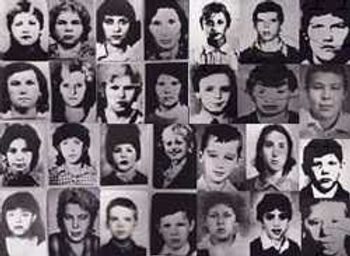
What can be said, from the assembled record, is this: most of them were vulnerable at the moment they met him. The children were alone at train stations without adults. The women were often runaways, or people who had fallen through the cracks of the Soviet social system, or people who simply needed directions and accepted help from the wrong man. They were people whose circumstances — the poverty, the disruption, the social fragility of late Soviet life — had placed them on platforms and at bus stops where a supply clerk with a briefcase could approach them without immediate suspicion. They deserved the protection that the state they lived in was, for ideological and institutional reasons, not providing them. The failure to provide that protection was not a minor administrative shortfall. It was the condition that made fifty-two murders possible.
And then there is Alexander Kravchenko, twenty-five years old when he was arrested in 1978, executed in 1984. He was not one of Chikatilo’s victims in any direct sense. He was the victim of the investigation that failed to catch Chikatilo while catching someone easier instead. He has not been publicly exonerated in Russian criminal law — the post-Soviet Russian state has not, to the best of available public record, issued a formal posthumous acquittal. He has been acknowledged in the historical literature on the case as almost certainly innocent. That acknowledgement is not nothing. It is also not enough.
A Final Note
The Chikatilo case is, in the literature of serial homicide, one of the most important in the twentieth century — not because of the number of victims, though the number is extraordinary, but because of what the case demonstrates about the relationship between institutional ideology and criminal investigation. Western audiences in the 1990s often framed the case as evidence of Soviet incompetence. That framing is partially right and substantially misleading. The investigators who eventually caught Chikatilo — Kostoyev, Bukhanovsky, and their teams — were not incompetent. They were operating within a system whose rules made competent investigation of exactly this kind of crime structurally very difficult. The ideology that prohibited the acknowledgement of serial killing was not a minor eccentricity of Soviet bureaucracy. It was a direct operational constraint that shaped what resources were allocated, what information was made public, what categories of investigation were permitted, and what conclusions could be officially reached.
The parallel with the Yorkshire Ripper investigation, which took place at roughly the same time in a very different political context, is instructive rather than exact. Both investigations were compromised by institutional commitments that distorted their handling of the evidence. In the Sutcliffe case it was misogynistic attitudes about which victims mattered. In the Chikatilo case it was ideological commitments about what kinds of crime could exist in a socialist state. In both cases the consequence was the same: killings continued that should have been stopped, and people died who should have lived.
The Soviet Union that produced Chikatilo, that executed Kravchenko in his place, that suppressed the investigation for years behind a wall of ideological denial, dissolved in December 1991, three months before his trial began. He was tried, convicted, and executed by the Russian Federation that replaced it. Russia has not, to the best of available knowledge, conducted the kind of sustained public reckoning with the investigation’s failures that the case warrants. The files exist. The record exists. The names of the dead exist. What has not yet been produced is the official acknowledgement of all that was done and not done in the twelve years between the death of Yelena Zakotnova and the arrest of the man who killed her — and of the man who was shot in his place.
That reckoning is owed. To Yelena Zakotnova. To Alexander Kravchenko. To fifty-one other people whose names are in the files and whose deaths were preventable if the state they lived in had been willing to see what was actually in front of it.