A warning before this article. The Whitechapel murders involved sustained physical mutilation of the dead, and any honest account of them must say so. This piece does not dwell on graphic detail beyond what the case requires, but the killings were extraordinarily violent and the descriptions that follow reflect that. The article also takes seriously the historian Hallie Rubenhold’s recent argument that the women at the centre of the case have, for 137 years, been the part of the story least carefully told. Where it is possible to put their names and lives first, this article does.
Part One: The Autumn of Terror
In the autumn of 1888, in a square mile of east London bounded by Aldgate, Spitalfields, Whitechapel, and Stepney, an unidentified man murdered at least five women in the space of ten weeks. He cut their throats. He mutilated their bodies. He left them in the streets and yards of the East End for whoever happened along to find. He wrote letters — or somebody did — taunting the police, signing himself first “Jack the Ripper” and later “From Hell.” He was never caught. He may have killed more women, both before and after the canonical five. He may have killed fewer. The full truth has been argued over for 137 years, and will probably be argued over for another 137.
The Whitechapel of 1888 was the poorest district of the wealthiest city in the world. It was a place of seven-storey tenements where families of eight shared single rooms, of common lodging-houses where a fourpenny “doss” bought a bed for a night, of streets so dark after dusk that residents carried matches to find their way home. It was an immigrant district, with substantial Irish, Jewish, and Eastern European populations, the latter newly arrived from the Russian pogroms of the early 1880s. It was a district of casual labour — dock work that ran out when ships did not come in, sweatshop tailoring that paid by the piece, costermongering, hawking, sweeping, and the desperate trades of last resort. It was a district where, according to a 1888 survey by the Metropolitan Police, approximately 1,200 women were working as prostitutes — not because they had chosen a profession but because the alternative was the workhouse, and the workhouse was, in the language of the time, the place women went to die.
Into this district, in the small hours of 31 August 1888, walked a man who would, by the time autumn had ended, become the most famous unidentified murderer in human history.
Part Two: Polly Nichols
Mary Ann Nichols — known to those who knew her as Polly — was forty-three years old when she was killed in the early hours of Friday 31 August 1888 in Buck’s Row, Whitechapel. She had been born in 1845 to a working family in Dean Street, off Fetter Lane, in central London. Her father, Edward Walker, was a blacksmith. She had married a printer named William Nichols when she was eighteen, and the marriage had produced five children. By 1881 it had broken down — there were accusations on both sides involving William’s infidelity and Polly’s drinking — and Polly had begun the slow descent through the city’s institutional system: the workhouses of Lambeth and Edmonton, the casual wards, the streets. In 1888 she was estimated to be sleeping rough or in common lodging-houses for most nights of the week. She had no fixed address. She had no fixed prospects. She had been heard, on the evening before her death, saying she had earned and spent her doss money three times already that day and would have no difficulty earning it again.
Around 3:40 a.m. on 31 August, a carter named Charles Cross — a name that would, more than a century later, become controversial — was walking to work along Buck’s Row when he noticed what he initially took to be a tarpaulin lying against the gates of a stable yard. As he came closer, he realised it was a woman. He was joined within minutes by another carter, Robert Paul. The two men examined Polly Nichols by the light of a nearby lamp. Her skirts were pulled up. She felt cold to the touch, though Paul thought he detected a faint movement of breath. They did not see the wounds in the darkness. They walked on to find a policeman.
The wounds, when the police saw them under proper light, were extensive. Polly Nichols’ throat had been cut twice, the second cut so deep that the spinal column was visible. Her abdomen had been opened by a series of jagged cuts from the breastbone to below the navel. Her intestines were partially exposed. The mutilations had been done quickly — investigators estimated within minutes of her death — and required the killer to have remained in close physical contact with the body for some moments. The street had been quiet. No-one had heard her cry out. The killer had moved through Buck’s Row without being seen.
This was Mary Ann Nichols. She was the first canonical victim of Jack the Ripper. She had been, in life, a printer’s wife, a mother of five, a woman who had separated from her husband, who drank, who had survived in the East End for as long as she had by knowing where to find a bed when she could not afford one. She would, after her death, become “the prostitute Polly Nichols” in the popular imagination, even though the historical evidence of her sexual labour is, by the lights of modern historians like Rubenhold, ambiguous. She was, certainly, a woman who slept rough. Whether she was, on the night of her death, soliciting customers in Buck’s Row is something the available record does not actually establish. What the record does establish is that she was dead in a stable-yard gateway by 3:40 a.m., and that the man who killed her had vanished into the dark before anyone passing by could see him.
Part Three: Annie Chapman
Eight days after Polly Nichols was killed, on Saturday 8 September 1888, a man named John Davis went down into the back yard of 29 Hanbury Street at approximately 5:55 a.m. to use the outside privy. In the gap between the back door and the cellar entrance, he found a woman lying on her back. He turned and ran back into the house, shouting for help.
The woman was Annie Chapman, forty-seven years old, known in the neighbourhood as Dark Annie. She had been born Annie Eliza Smith in Paddington in September 1841. Her father was a soldier in the Life Guards. She had married a coachman named John Chapman in 1869 and had three children, two of whom survived infancy. The marriage had been comfortable enough in its early years — the Chapmans had lived in Berkeley Square and then in the staff cottages of Sir Francis Tress Barry’s Windsor estate, where John worked as a head domestic — but by the early 1880s it had collapsed under the weight of Annie’s drinking. She had separated from her husband, who continued to send her ten shillings a week until his death in 1886, and had moved into the East End. By 1888 she was living in common lodging-houses in Dorset Street and supporting herself through occasional crochet work, the sale of flowers, and, by some accounts but not all, prostitution.
The mutilations inflicted on Annie Chapman were more extensive than those on Polly Nichols. Her throat had been cut almost to the spine. Her abdomen had been opened from the pubis to the breastbone. Her intestines had been removed from her body and laid over her right shoulder. Her uterus, the upper portion of her vagina, and most of her bladder had been excised and taken away. The post-mortem examination by Dr George Bagster Phillips, the divisional police surgeon, concluded that the removal of these organs had been performed by someone with anatomical knowledge, possibly the knowledge of a doctor or a butcher, and that the work had been done in approximately fifteen minutes — fast, in the dark, in a back yard that other tenants of the building could have walked into at any moment.
The Chapman murder produced two important things. The first was a witness. A market porter’s wife named Elizabeth Long told police that at approximately 5:30 a.m. she had walked past 29 Hanbury Street and seen a man and a woman standing together in front of it. She identified the woman, from a photograph, as Annie Chapman. The man, she said, had been a “shabby genteel” type, about 5’7″, wearing a deerstalker hat and a dark overcoat, and had spoken with what she described as a foreign accent. She had heard him say to the woman, “Will you?” and had heard her reply, “Yes.”
The second was the public reaction. The Chapman killing transformed the case from a local horror into a citywide and then national emergency. The Pall Mall Gazette ran the story across multiple editions. The cheap evening papers — the Star, the Echo, the Evening News — competed for the most lurid possible account. The phrase “Whitechapel murders” entered general use. The Home Secretary, Henry Matthews, was questioned in the House of Commons. Queen Victoria began making private inquiries through her ministers about what was being done. By the second week of September 1888, the East End of London was, in the language of the contemporary press, in a state of “wild excitement and unutterable terror.”
Part Four: The Double Event
Three weeks passed before the killer struck again. The Metropolitan Police, under Sir Charles Warren, expanded patrols, recruited additional plainclothes officers, and conducted house-to-house searches across parts of Whitechapel and Spitalfields. The Whitechapel Vigilance Committee, an organisation of local tradesmen formed in the wake of the Chapman murder, hired private detectives and offered rewards for information. The killer, whoever he was, seemed to be waiting.
On the night of 29–30 September 1888, he did something he had not done before: he killed twice in the same night.
The first victim of what would become known as the “Double Event” was Elizabeth Stride, a forty-four-year-old Swedish-born immigrant. She had been born Elisabeth Gustafsdotter on a farm in Stora Tumlehed, near Gothenburg, on 27 November 1843. Her early life in Sweden had been hard — she had worked as a domestic servant, become pregnant out of wedlock, been registered with the local police as a prostitute, and lost a stillborn daughter — and in 1866 she had emigrated to London. She had married a carpenter named John Stride in 1869 and had run a small coffee room with him in Poplar before the business failed. By 1888, twice-widowed and living in common lodging-houses in the East End, she was forty-four years old and was known to the local police, by her own account, as someone who occasionally turned to prostitution to supplement her income from domestic work and sewing.
Stride was found at approximately 1 a.m. on 30 September in Dutfield’s Yard, off Berner Street, by a Russian-Jewish jewellery hawker named Louis Diemschütz, who had returned to the International Working Men’s Educational Club where he was steward and had driven his pony and cart into the yard. The pony shied at something on the ground. Diemschütz struck a match and saw Elizabeth Stride lying on her left side, her throat cut.
The Stride killing differed from the previous two in one critical respect: there were no mutilations. Her throat had been cut, severing the left carotid artery, and that was all. The most plausible interpretation, accepted at the time and largely accepted since, is that the killer had been interrupted by Diemschütz’s arrival — that he had been about to begin the abdominal work and had been forced to flee. Whether this means he then walked across the city to find another victim, or whether he had already had another victim in mind, is something the available evidence does not settle. What is certain is that within the next forty-five minutes he had located and killed a second woman, three-quarters of a mile away.
That woman was Catherine Eddowes, forty-six years old, known to friends as Kate. She had been born in Wolverhampton in April 1842 to a tinsmith and his wife. Her family had moved to London when she was a small child. She had been a bright girl who learned to read and write at the Dowgate charity school. As a young woman she had run away from a domestic service position to live with a former soldier and pedlar named Thomas Conway, with whom she had three children. Conway had eventually left her, in part because of her drinking. By the late 1880s she was living with a market porter named John Kelly in common lodging-houses in Flower and Dean Street, and worked seasonally — picking hops in Kent in the autumn, doing what she could in London the rest of the year.
On the evening of 29 September, Eddowes had been arrested for drunkenness on Aldgate High Street and held in the cells at Bishopsgate police station to sober up. She was released at 1 a.m. on the morning of 30 September. The duty sergeant who released her, George Hutt, asked her where she was going. She said she was going home. She walked out of the station into the cold East End night and was dead within forty-five minutes.
Catherine Eddowes was found in Mitre Square, in the south-east corner of the City of London, at approximately 1:45 a.m. by Police Constable Edward Watkins, who had walked his beat through the same square fifteen minutes earlier and seen nothing. The mutilations were the most extensive yet inflicted. Her throat had been cut. Her face had been disfigured by a series of cuts, including triangular incisions to both cheeks and a slicing-off of the tip of her nose and a portion of her right earlobe. Her abdomen had been opened from breastbone to pubis. Her intestines had been pulled out and laid over her right shoulder, with one section detached and placed between her body and her left arm. Her left kidney had been removed and taken away. Her uterus had also been excised, with the cervix cut so cleanly that the police surgeon who examined her, Dr Frederick Gordon Brown, considered the work to be that of someone with significant anatomical training.
The double event of 30 September was the moment the case achieved a kind of escape velocity in the public imagination. Two killings, in two jurisdictions, within forty-five minutes. The killer was not only still at large; he was, by any reasonable reading, escalating. And, within hours, he began to write.
Part Five: The Letters
On the morning of 27 September 1888 — three days before the double event — the Central News Agency in London had received a letter in red ink, written in a neat hand, addressed to “The Boss.” The agency held it back for two days before forwarding it to Scotland Yard, suspecting it might be a hoax. After the double event of 30 September the letter took on a new significance. It read, in part:
Dear Boss, I keep on hearing the police have caught me but they wont fix me just yet. I have laughed when they look so clever and talk about being on the right track. That joke about Leather Apron gave me real fits. I am down on whores and I shant quit ripping them till I do get buckled. Grand work the last job was. I gave the lady no time to squeal. How can they catch me now. I love my work and want to start again. You will soon hear of me with my funny little games.
The signature was Yours truly, Jack the Ripper. It was the first time the name appeared in the historical record. Within days it had been published in newspapers across the country and within a week it was being used in households across the English-speaking world.
A second communication arrived at the Central News Agency on the morning of 1 October — a postcard, written in the same red ink and apparently the same hand, referring to “the double event” of the previous night in terms that demonstrated knowledge the writer ought not to have had if he was simply a hoaxer reading the morning papers. The postcard was signed in the same name and used the same phrasing, including “saucy Jack.”
Whether the Dear Boss letter and the postcard were genuinely from the killer has been argued ever since. The Metropolitan Police, both at the time and in the years following, came to believe they were the work of a journalist seeking to keep the story alive — Inspector Frederick Abberline, the senior detective on the case, specifically named the journalist Tom Bulling as a possible author in his retirement. But the name the journalist gave the killer, if it was a journalist, attached itself to the case with a permanence that no subsequent intervention has dislodged.
A third communication, posted on 15 October 1888 to the Whitechapel Vigilance Committee, has a stronger claim to authenticity. Addressed to its chairman, George Lusk, it was accompanied by a small cardboard box containing what was later medically identified as half of a human kidney, preserved in spirit of wine. The letter read:
From hell. Mr Lusk, Sor, I send you half the Kidne I took from one woman prasarved it for you tother piece I fried and ate it was very nise. I may send you the bloody knif that took it out if you only wate a whil longer. Catch me when you can Mishter Lusk.
The kidney, when examined, was found to be from an adult human, taken from a body within recent weeks, and to show signs consistent with the chronic alcoholism that Catherine Eddowes was known to have suffered from. Whether it actually was Catherine Eddowes’ kidney has never been conclusively established — the necessary tests did not exist in 1888 — but the medical evidence available was strongly consistent with that conclusion. The letter, unlike the Dear Boss communications, is one that most modern Ripper scholars consider likely to be genuine.
Part Six: Mary Jane Kelly
The killings appeared to have stopped after the double event of 30 September. October passed without further attacks. The Whitechapel investigation, by early November, had become a vast and increasingly fruitless administrative effort: more than two thousand interviews conducted, three hundred suspects examined, eighty thousand handbills distributed. The pressure on Sir Charles Warren was enormous. He resigned as Metropolitan Police Commissioner on 9 November 1888.
On the morning of the same day, the most violent of the Whitechapel murders was discovered.
Mary Jane Kelly was the youngest of the canonical victims. She was approximately twenty-five years old at the time of her death — the records of her early life are unusually thin, and the most thorough modern research, by Rubenhold and others, has not been able to verify the various accounts she gave of her own history. She had told friends she had been born in Limerick around 1863 and raised in Wales, that her father had been an ironworker, that she had married a coal miner named Davies who had been killed in a pit explosion, that she had spent time in Cardiff and then moved to a high-class West End brothel before falling into the East End. Some of these claims may have been true. Others were almost certainly her own invention, the kind of identity-construction that women in her circumstances often produced as a way of placing themselves more comfortably in their own lives. What is certain is that by 1888 she was living in a single room at 13 Miller’s Court, off Dorset Street, with a fish porter named Joseph Barnett with whom she had separated only a week before her death, and that she supported herself, by every available account, almost exclusively through prostitution.
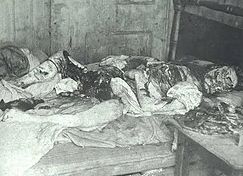
At approximately 10:45 a.m. on 9 November 1888, Mary Kelly’s landlord John McCarthy sent his assistant Thomas Bowyer to collect rent arrears from Room 13. Bowyer knocked. There was no answer. He went round to the side of the building, where a window had been broken some weeks earlier and the broken pane filled with a piece of cloth. He pulled back the cloth. He looked in.
What the killer had done to Mary Jane Kelly is the part of the Whitechapel case that this article will not describe in detail. It is enough to say that he had been alone with her in her own room, with privacy and time he had not previously enjoyed, and that he used both. The mutilations went far beyond anything inflicted on the four previous victims. Her face was made unrecognisable. Internal organs were excised and arranged around the room. Her heart was removed and taken away, the only one of the killer’s confirmed trophies whose disposition is now unknown — it is presumed, in the absence of any other explanation, to have left the building with him.
The crime scene photograph taken at 13 Miller’s Court on the afternoon of 9 November is the only surviving photograph of any of the canonical victims at the moment of their discovery. It is preserved in the Metropolitan Police archive.
The Kelly killing was the last canonical Ripper murder. There were further violent deaths of women in the East End in the following months and years — Rose Mylett in December 1888, Alice McKenzie in July 1889, Frances Coles in February 1891, the Pinchin Street torso in September 1889 — and the Metropolitan Police file on the Whitechapel murders included all of these. Whether any of them were committed by the man who had killed in autumn 1888 has been argued about for 137 years. The honest historical answer is that we do not know.
Part Seven: The Investigation
The Metropolitan Police investigation of the Whitechapel murders was, by the standards of 1888 policing, enormous, and by the standards of any modern force, hopeless. It was led by Detective Inspector Frederick Abberline in operational terms, with Chief Inspector Donald Swanson supervising at Scotland Yard and Assistant Commissioner Sir Robert Anderson responsible at the most senior level. The investigation eventually involved hundreds of officers, the deployment of plainclothes detectives across Whitechapel night after night, and the systematic interview of nearly every man living in the relevant streets.
What it lacked was almost everything that modern police investigation would consider essential. There was no fingerprinting — the technique had been theorised but not yet implemented in British policing. There was no blood-grouping, let alone DNA. Photography of crime scenes was inconsistent. Witness statements were taken without standardised procedure. The two police forces involved — the Metropolitan Police, responsible for most of Whitechapel, and the City of London Police, responsible for the small jurisdiction in which Catherine Eddowes had been killed — competed rather than cooperated, withholding information from each other in the way that English police forces of the period habitually did.
The single most catastrophic operational decision of the case was made on the morning of 30 September, in the hours after the Eddowes murder, when officers found a fragment of bloody apron in a doorway at 108-119 Goulston Street. Above the apron, in chalk on the wall, someone had written: The Juwes are the men That Will not be Blamed for nothing. The misspelling, the phrasing, the placement of the fragment of Eddowes’ apron directly beneath the inscription — all of it suggested that the killer had paused there in his flight from Mitre Square. The City of London Police photographer was sent for. He had not yet arrived when Sir Charles Warren himself reached the scene. Warren made the decision, against the protests of his own officers, to order the inscription washed away before it could be photographed. He was concerned, he later explained, that the message might trigger anti-Jewish riots in the East End in the morning if it were seen and reproduced. The reasoning was not entirely unreasonable — anti-Jewish feeling in Whitechapel that autumn was real, and other inflammatory speculations had been printed about a Jewish suspect called “Leather Apron” — but the consequence of Warren’s decision was that one of the only pieces of physical evidence that may have been left by the killer himself was destroyed by the senior police officer in charge of catching him. No transcription of the chalk inscription that survives entirely agrees with any other transcription. We do not know, even now, exactly what the words said.
By the end of 1888, the Metropolitan Police investigation had largely run out of leads. By 1891 it had effectively wound down. The Whitechapel file was, in the language of Scotland Yard, never officially closed, but it ceased to be a working investigation. The murderer was not in custody. He had not been identified. He had simply, after Mary Jane Kelly, stopped.
Part Eight: The Suspects, Part One — The 1888 Names
It is a feature of the Ripper case that more than 500 individuals have, at various points in the past 137 years, been named as suspects. The list ranges from credible Whitechapel-based contemporaries with documented psychiatric histories to King Edward VII’s son, to Lewis Carroll, to the artist Vincent van Gogh. Most of these can be dismissed in a sentence. A smaller number have attracted sustained attention and deserve more careful treatment.
The most authoritative early list of suspects was produced by Sir Melville Macnaghten, who became Assistant Chief Constable of the Metropolitan Police in 1889 and Assistant Commissioner in 1903. In a private memorandum written in February 1894, Macnaghten named three men whom Scotland Yard considered the most likely suspects.
The first was Montague John Druitt, a thirty-one-year-old barrister and schoolmaster from Dorset. Druitt had been a competent cricketer who played for the MCC and Kingston Park; he had also, in late November 1888, been dismissed from his teaching position at the Valentine’s School in Blackheath for reasons that have never been publicly clarified. On 1 December 1888 he killed himself by walking into the Thames near Chiswick with stones in his pockets. His body was recovered on 31 December. Macnaghten, writing five years later, asserted that “from private information I have little doubt but that his own family believed him to have been the murderer.” What the private information was, who in the family had said what, and whether Macnaghten was reproducing an accurate account or laundering a rumour that had been improving in the telling — none of this can now be established. The case against Druitt rests on the chronological coincidence of his suicide with the apparent end of the Ripper murders, the alleged family suspicion, and the supposition that a man capable of teaching cricket and constructing chambers law might also have been capable of disembowelling prostitutes in Whitechapel. The case against the case is that Druitt is not known ever to have been in Whitechapel, that he had no obvious medical or anatomical training, and that the private information Macnaghten relied on was thin to the point of vanishing.
The second was Michael Ostrog, a Russian-born petty criminal with a long record of theft and confidence-trickery who had spent significant periods in lunatic asylums and convict prisons. Macnaghten described him as “a mad Russian doctor and a convict and unquestionably a homicidal maniac.” Ostrog has been almost entirely dismissed by modern researchers, in part because subsequent records have shown he was probably in a French prison during at least some of the Whitechapel murders.
The third was Aaron Kosminski, a twenty-three-year-old Polish-Jewish hairdresser who lived with his sister and brother-in-law in Sion Square, Whitechapel. Kosminski had emigrated from Poland in the early 1880s. By 1888 he was, by the accounts of family members and the Whitechapel doctors who later assessed him, deeply mentally ill — he was diagnosed with what later medicine would call paranoid schizophrenia, suffered from auditory hallucinations he attributed to outside forces, and showed sustained behavioural disturbance including the practice of eating food from gutters and refusing to bathe. He was committed to Colney Hatch Lunatic Asylum in February 1891 and lived in institutional care, mostly at Leavesden Asylum, until his death in 1919. The case for Kosminski as the Ripper rests on the testimony of three senior officers — Macnaghten, Robert Anderson, and Donald Swanson — all of whom, in private documents or memoirs, identified a “Polish Jew” with Kosminski’s history as the Ripper. Anderson went further, claiming in his 1910 memoir that the Ripper had been identified by a Jewish witness who declined to give evidence against a fellow Jew. Swanson, in marginal annotations in his copy of Anderson’s book, named the witness’s chosen man explicitly as Kosminski.
This was the state of the case as the original investigators left it. Three suspects, none of them ever charged, with Kosminski occupying the central position by virtue of having been named by three senior officers independently.
Part Nine: The Suspects, Part Two — A Hundred Years of Speculation
Between the original investigation and the present, an industry of Ripper speculation grew up around the case that has produced, on a more or less continuous basis, new suspects whose putative identification has been argued with various degrees of seriousness. A handful of these have achieved the status of recurring fixtures in the literature.
Prince Albert Victor, Duke of Clarence and Avondale, was the eldest son of the future Edward VII and second in line to the British throne. He died of influenza in 1892 at the age of twenty-eight. The theory that he was the Ripper was first publicly aired by Dr Thomas Stowell in an article in The Criminologist in 1970, which suggested that “Albert Victor” had been driven mad by tertiary syphilis contracted in a West Indies brothel. The theory was elaborated by subsequent writers into an increasingly baroque conspiracy involving a Freemasonic cover-up, the royal physician Sir William Gull, and the painter Walter Sickert acting in various subordinate roles. Almost no part of the resulting “royal conspiracy” theory survives even modest scrutiny. Albert Victor’s documented movements during the autumn of 1888 place him in Scotland, Yorkshire, and Sandringham on dates when he would have needed to be in Whitechapel for the theory to work. The theory persists nonetheless because it satisfies a particular kind of narrative appetite about the British establishment, and because it provided the basis for several films and the Alan Moore graphic novel From Hell.
Sir William Gull, Physician-in-Ordinary to Queen Victoria and one of the most distinguished doctors of nineteenth-century England, was named in the same royal conspiracy theory as Albert Victor’s accomplice or enforcer. He was seventy-two years old in 1888, had suffered a serious stroke the previous year, and was by every available account in poor health. The notion that a debilitated elderly knight of the realm was killing prostitutes in Whitechapel as part of a Masonic ritual to protect a royal embarrassment is the kind of theory that, once it has been seriously stated, requires no rebuttal.
Walter Sickert, the English Impressionist painter, has been named as the Ripper repeatedly since the 1970s, most famously by the American crime novelist Patricia Cornwell in her 2002 book Portrait of a Killer: Jack the Ripper Case Closed, and its 2017 follow-up. Cornwell, who spent a reported several million dollars of her own money on the investigation including the destructive purchase and dismantling of original Sickert paintings, argued that Sickert had the artistic preoccupation with violence against women, the anatomical curiosity, and the personal pathology to fit the case. She supported the argument with mitochondrial DNA evidence from Sickert paintings and from Ripper letters which she claimed showed a match. The argument has not been accepted by mainstream Ripper historians or by the wider forensic community, on the grounds that mitochondrial DNA cannot identify specific individuals (it only excludes them or fails to exclude them), that most of the Ripper letters are now considered to be hoaxes by journalists and members of the public, and that Sickert can be documentarily placed in France during at least some of the canonical murders.
James Maybrick, a Liverpool cotton merchant who died in 1889 in circumstances that produced one of the most famous Victorian murder trials (his wife Florence was convicted of poisoning him; she was probably innocent), became a Ripper suspect in 1992 when a man named Michael Barrett produced what he claimed was the diary of Jack the Ripper, written by Maybrick. The “Maybrick Diary” identifies its author as a Liverpool merchant tormented by his wife’s infidelities who travelled to London to kill prostitutes as a kind of displaced revenge. The diary has been the subject of extensive forensic examination since its emergence. The handwriting does not match Maybrick’s known hand. The ink has been variously dated. Barrett himself, before his death in 2016, gave multiple contradictory accounts of how the diary came into his possession, including a confession to having forged it himself. Most serious researchers consider the Maybrick diary a modern fabrication, though it retains a small and committed circle of defenders who continue to argue otherwise.
This is the broad shape of the speculative literature: a recurring carousel of named suspects, almost all of them dismissable on the basis of either documentary evidence or basic plausibility, each retaining a small permanent constituency of believers.
Part Ten: The Suspects, Part Three — The Modern Two
Among the more than five hundred named suspects, only two enjoy substantial credibility in contemporary serious Ripper scholarship. They are Aaron Kosminski, recently revisited via DNA evidence, and Charles Lechmere, the carter who found Polly Nichols’ body.
The Kosminski case was given a substantial new boost in 2014 by the publication of Naming Jack the Ripper by the businessman Russell Edwards, who claimed to have established Kosminski’s guilt through mitochondrial DNA testing of a silk shawl purportedly taken from the scene of Catherine Eddowes’ murder. Edwards had acquired the shawl at auction in 2007. He had it analysed by Dr Jari Louhelainen of Liverpool John Moores University. Louhelainen concluded that the shawl contained DNA matching both Eddowes’ direct descendants and Kosminski’s direct descendants.
The Edwards-Louhelainen claim was repeated in extensive media coverage in 2014 and again in 2019 when a peer-reviewed paper appeared in the Journal of Forensic Sciences. It was, at every stage, met with serious objection from independent scientists. The objections fall into three categories. First, the chain of custody of the shawl is uncertain — there is no contemporary documentation placing it at the Mitre Square scene, and the story that it was taken by a Sergeant Amos Simpson as a gift for his wife is internally implausible and not supported by any 1888 record. Second, mitochondrial DNA cannot definitively identify an individual, only a maternal line, and the matches Louhelainen reported are with haplogroups that may be shared by millions of people. Third, the shawl has, in the 137 years since the murder, been handled by an unknown number of people whose DNA may have contaminated it, including the descendants of both Eddowes and Kosminski themselves. Even if the science were beyond reproach, the chain of custody is not. Most serious modern Ripper historians regard the Kosminski-shawl claim as suggestive but not conclusive.
The case against Kosminski on the non-DNA evidence is, however, still substantial. He was named by three independent senior Metropolitan Police officers. He lived within the murder district. He was psychiatrically severely unwell in ways that included violent fantasies. He was committed to an asylum at exactly the point at which the murders had effectively ended. The pattern fits, even if the shawl evidence does not close the case.
The other modern candidate is Charles Allen Lechmere, the carter who, under his stepfather’s surname Cross, discovered the body of Polly Nichols on Buck’s Row at 3:40 a.m. on 31 August 1888. The Lechmere theory, advanced most fully by the Swedish researcher Christer Holmgren in his 2021 book Cutting Point and by various documentary filmmakers in the years since, holds that Lechmere was not a passerby but the killer himself, caught in the act by Robert Paul’s approach and forced to bluff his way past Paul by pretending to be a fellow discoverer of the body. The case for Lechmere rests on several specific points. He gave his name to police as “Cross,” his stepfather’s name, rather than his legal surname Lechmere, which has been argued to be the behaviour of someone trying to obscure his identity. His established walking route to work passed through the locations of several of the Ripper murders at times consistent with the killings. His mother lived on Cable Street, near Berner Street where Elizabeth Stride was killed. There is no documentary evidence directly placing him at any of the murder scenes other than Buck’s Row, but the circumstantial proximity is striking.
The case against the Lechmere theory is that the circumstantial proximity is, by itself, no more than circumstantial. London carters who lived in the East End and worked at the Pickford’s depot near Broad Street station would naturally have walked routes that crossed Whitechapel in the small hours. The “Cross” name issue, while suggestive, is also explainable: he had been raised by his stepfather, had been using the Cross name in working contexts for years, and gave it to police in what may simply have been habit. The Lechmere theory has, in the past decade, acquired a vocal following on YouTube, in documentary films, and in certain corners of the Ripperologist community, but it has not been accepted as established by most academic researchers.
The honest assessment, on the suspects as they currently stand, is that no candidate produces evidence sufficient to identify him as the killer to a reasonable historical standard, and that the two who come closest — Kosminski on the strength of the period police testimony, Lechmere on the strength of the situational coincidence — remain candidates rather than conclusions.
Part Eleven: The Names That Matter
The historian Hallie Rubenhold published The Five: The Untold Lives of the Women Killed by Jack the Ripper in 2019 to substantial acclaim and to a small but vocal counter-current of Ripperologist objection. The book’s argument is straightforward. The case has, for 130 years, been told as the story of a killer — his identity, his methods, his psychology, his eventual unmasking. The women he killed have been reduced to a list of names, occupations, ages, and post-mortem injuries. Rubenhold returns to the archival record — birth and marriage and census documents, workhouse and asylum admissions, court and police records, family letters where they survive — and reconstructs the lives of Polly, Annie, Elizabeth, Catherine, and Mary Jane as the biographies they actually were before they became the corpses they ended up as.
The reconstruction is, in many places, profoundly affecting. Polly Nichols emerges as a woman who had been employable, who had raised five children, whose marriage failed in part because of the early-Victorian double standard around alcohol and the casual abuse women in her social class were expected to absorb. Annie Chapman emerges as a woman who had lived comfortably for years in domestic service positions on landed estates and whose descent into the East End was the slow consequence of grief and addiction rather than the simple operation of “the gutter.” Elizabeth Stride, the Swedish immigrant, emerges as someone whose register as a Gothenburg prostitute in the 1860s reflected the brutal regulatory regime of nineteenth-century Sweden as much as it reflected her own choices, and whose subsequent life in London was substantially more conventional than her earlier years. Catherine Eddowes emerges as a Wolverhampton girl who could read and write, who had three children, who picked hops every September with the man she loved, and who was killed on the night she had finally secured the few shillings she needed to get back to her family. Mary Jane Kelly emerges as the youngest, the most enigmatic, the woman whose biography is most resistant to historical reconstruction, but who in her last years had been trying to build a domestic life with Joe Barnett in a single room off Dorset Street.
Rubenhold’s most contested claim is that only two of the five women — Mary Jane Kelly and Elizabeth Stride — can be conclusively shown to have been working as prostitutes at the times of their deaths, and that the universal contemporary assumption that all five were “prostitutes” reflects late-Victorian misogyny more than it reflects evidence. The claim has produced sustained pushback from some Ripperologists, who note that the documentary record on Polly Nichols, Annie Chapman, and Catherine Eddowes contains material that is at least consistent with occasional sex work. The fair reading, in the present author’s view, is that all five women were undoubtedly homeless or near-homeless at the times of their deaths, that the line between casual prostitution and other survival strategies for women in their circumstances was thin and porous, and that Rubenhold’s central point — that they have been crushed into a single sensational category that does not represent the actual particularity of their lives — is largely correct regardless of how the prostitution question is finally resolved.
What is harder to dispute is the simple recovery of their names as something more than appendages to the killer’s. Polly. Annie. Elizabeth. Catherine. Mary Jane. They were daughters and mothers and wives. They had ages and birthplaces and occupations and accents. They had survived for decades in the hardest part of the wealthiest city in the world, by intelligence and effort and the small kindnesses of friends. They did not, by any reasonable standard, deserve what was done to them, and they did not deserve the 137 years of being remembered only as the prelude to their own murders. The recovery of their actual lives is the most important thing that has happened in Ripper scholarship in the past three decades.
A Final Note
The Whitechapel of 1888 is now, in physical terms, almost entirely gone. The streets remain in their original layout, the names mostly preserved, but the buildings are different. Buck’s Row was renamed Durward Street in 1892, partly to allow residents to feel they no longer lived in a Ripper street. The Board School at the end of Buck’s Row still stands and is now a private apartment building. 29 Hanbury Street was demolished in the 1960s to make way for the expansion of the Truman Brewery; the brewery itself has since closed and the site is now retail. Berner Street was renamed Henriques Street and is now an unremarkable residential stretch. Mitre Square remains, in name and approximate layout, though the buildings around it are entirely different. The site of 13 Miller’s Court was redeveloped in the early twentieth century and lies under what is now a multi-storey car park.
The case is, by every meaningful measure, the foundational unsolved murder mystery of modern Western culture. It has produced books, films, plays, operas, paintings, walking tours, theme park attractions, museums, podcasts, video games, and an entire academic adjacent discipline that calls itself Ripperology. The London tourist industry continues to extract substantial revenue from it. Walk down Whitechapel High Street on any evening in the year and you will see groups of fifteen or twenty tourists being led, by guides with lanterns and Victorian hats, through the streets where Polly Nichols and Annie Chapman were killed.
What has not happened, in 137 years, is the solving of the case. The advance of forensic science has not closed it. Genealogical DNA, which has solved cases of comparable age such as the Golden State Killer murders, cannot easily be applied to physical evidence from 1888 — the chain of custody is in most cases broken, the surviving materials are limited and contaminated, and the records of potential suspects’ descendants are increasingly thin. The case will, in all probability, never be solved. The man who killed Polly, Annie, Elizabeth, Catherine, and Mary Jane will remain, in the strict historical sense, unnamed.
What can be done — and what Hallie Rubenhold and other recent scholars have begun to do — is to ensure that the women he killed are no longer the unnamed part of the story. The killer wanted, more than anything, to be remembered. He chose his name. He wrote his letters. He arranged his crime scenes for maximum public effect. He succeeded so completely that 137 years later schoolchildren in Australia and shop assistants in Nebraska can recite his chosen alias.
The women did not choose. They had names of their own before the killer took them, and they have names now after the killer has gone. Polly Nichols. Annie Chapman. Elizabeth Stride. Catherine Eddowes. Mary Jane Kelly. They deserved better in life, and they deserve better in memory. The rest of the case — the suspects, the letters, the eternal speculation — is, in the proper accounting, footnotes.