On the afternoon of 18 November 1978, in a clearing in the Guyanese jungle, 918 people died. Most of them were poisoned. Some of them were children. Their leader, a man who had once been celebrated by mayors and congressmen as a moral force in American religious life, was found among them with a gunshot wound to his head. This is the full account of how a small church in Indianapolis became, over twenty-four years, the largest civilian death in modern American history.
Part One: The Boy from Crete
James Warren Jones was born on 13 May 1931 in the village of Crete, Indiana, near the town of Lynn. His father, James Thurman Jones, was a disabled World War One veteran exposed to mustard gas in France, broken in body and spirit, drinking heavily, occasionally affiliated with the Ku Klux Klan. His mother, Lynetta, was a factory worker and a woman of strong personality who believed, by her own account, that she had given birth to a messiah.
It was a strange childhood by any measure. The Jones family moved to nearby Lynn when Jim was a small boy, into a clapboard house without indoor plumbing. Neighbours later remembered him as an unsettling child — bright, intense, preoccupied with death and religion in ways that made other children uncomfortable. He kept a small graveyard for animals in the backyard and held funerals for them. He was said to have once locked a friend in a barn at gunpoint to make a theological point. By the age of ten he was reading the Bible obsessively. By his early teens he was preaching sermons on street corners to anyone who would listen.
What is striking about Jones from the earliest accounts is the consistency of two themes that would define his entire life. The first was racial equality, an unusual conviction for a poor white boy in 1940s Indiana, but one he held with absolute seriousness. He sought out Black neighbours, refused to use the racial slurs his father did, and was, by his own later telling, on the receiving end of significant violence from his father over the question. The second was a hunger to be the centre of attention — for the worshipful regard of others, for control over what they believed and did. These two threads, the genuine convictions and the genuine narcissism, were never fully untangled in him. The tragedy of Jim Jones is partly that they remained intertwined to the end.
Part Two: The Indianapolis Years
Jones graduated from high school in 1949, married a nurse named Marceline Baldwin in 1949, and enrolled at Indiana University, eventually transferring to Butler in Indianapolis where he earned a degree in 1961. By the mid-1950s he was already preaching. In 1954 he founded a small independent congregation in Indianapolis that he initially called the Community Unity Church. In 1955 he renamed it Wings of Deliverance, and shortly after that, Peoples Temple Full Gospel Church.
The Peoples Temple was, from the beginning, racially integrated in a way that almost no American church was in 1955. Jones recruited Black members aggressively. He and Marceline adopted a Black son, Jim Jones Jr, in 1961, becoming one of the first white couples in Indiana to adopt a Black child. They also adopted Korean and Native American children. Jones called his household his “rainbow family” and held it up as a model of what he believed America should be.
This work, in segregation-era Indiana, was genuinely brave. The Temple ran soup kitchens. It found jobs for unemployed members. It helped integrate Indianapolis restaurants and hospitals. Jones served on the city’s Human Rights Commission. When his congregation faced threats — a swastika painted on the church, dead animals on the porch, a stick of dynamite found near the building — he responded by becoming more visible, not less.
The first signs of what the Temple would later become were also present, however, for anyone who was watching. Jones began claiming healing powers, conducting public “miracles” that were later revealed to involve planted shills and disguised animal organs presented as cancerous tumours removed from believers. He demanded financial commitment from members — eventually, in many cases, the surrender of their entire savings and homes to the church. He began describing himself in messianic terms, hinting that he was the reincarnation of Jesus, Buddha, and Lenin all at once. His congregation, drawn in by his real work on civil rights, found themselves agreeing to things that, taken on their own, they would never have agreed to.
Part Three: The Move to California
In 1965, Jones moved the Temple to Redwood Valley, a small community in Mendocino County in northern California. The official reason was that he had been studying lists of locations likely to survive a nuclear war — an article in Esquire magazine had identified northern California as one of the safest places in the United States. The unofficial reason, less remarked upon at the time, was that Indianapolis was beginning to ask uncomfortable questions about his finances and his claimed miracles. California offered a fresh start.
It also offered, in the late 1960s and early 1970s, a population uniquely receptive to what Jones was selling. The civil rights movement had created a constituency hungry for racial reconciliation that the mainstream churches were not providing. The anti-war movement had created a constituency of young people disillusioned with American institutions. The collapse of the 1960s counterculture had left thousands of people looking for new structures of meaning to replace the ones that had failed them. Jones offered all of it at once: integrated worship, socialist economics, prophetic urgency, communal living, the promise that they were participants in something that mattered.
By 1970, Peoples Temple had opened a branch in San Francisco, and by 1972 another in Los Angeles. The San Francisco operation eventually became the headquarters. Jones, with his sunglasses and slicked-back hair and operatic preaching style, became a recognisable figure in California civic life. The Temple ran a fleet of buses that brought members from across the state to his services. It operated nursing homes, drug rehabilitation centres, a free legal aid service. It produced votes — thousands of them, organised and deliverable — that local politicians wanted.
In 1976, San Francisco mayor George Moscone appointed Jones chairman of the San Francisco Housing Authority Commission. Jones met with Walter Mondale during the 1976 presidential campaign and with First Lady Rosalynn Carter at a public event in 1977. He was photographed shaking hands with Jerry Brown and Willie Brown. Harvey Milk, the gay rights activist later assassinated alongside Moscone, wrote to Jones in glowing terms. The Temple’s political power in San Francisco, at its peak in 1976 and 1977, was real and very widely courted.
Behind the scenes, however, the Temple was tightening into something closer to a totalitarian institution. Members were required to attend services lasting six or eight hours. They were subjected to “catharsis sessions” in which they were publicly humiliated, beaten, and sometimes sexually assaulted as a form of discipline. They surrendered control of their money, their homes, in many cases their children, to the church. Jones began having sexual relationships with both female and male members of his inner circle, framing these as acts of revolutionary leadership. He used barbiturates and amphetamines in increasing quantities. His sermons became less religious and more political, more paranoid, more apocalyptic.
Members who tried to leave were threatened, surveilled, in some cases beaten. The Temple maintained a security force — initially for protection against the real racist threats it had faced, but increasingly used to police its own members. Children of members were used as leverage to keep parents from defecting. A small but growing group of former members began telephoning journalists and government officials with allegations the mainstream press was, for years, reluctant to take seriously.
Part Four: New West Magazine
The reckoning began with a magazine article. In August 1977, New West, a California regional magazine, published a long investigative piece by Marshall Kilduff and Phil Tracy detailing the financial fraud, physical abuse, and coercion inside Peoples Temple. The reporters had interviewed multiple former members. They had documented specific incidents of violence. They had traced the money flows. The article was careful, sourced, and devastating.
Jones knew the piece was coming. He had been planning, for several years, the establishment of an overseas sanctuary that would allow him to operate beyond the reach of American journalists, courts, and government agencies. In 1974, the Temple had leased a large tract of land in the South American nation of Guyana — a former British colony, English-speaking, with a left-wing government sympathetic to American socialists and far enough from the United States that pursuit would be expensive and difficult. A small group of Temple members had begun clearing jungle and building structures at the site, which Jones named Jonestown after himself.
In the summer of 1977, with the New West article imminent, Jones gave the order to begin the mass migration. Over the following months, more than a thousand Peoples Temple members — many of whom had been told they were going on a temporary visit — flew from California to Georgetown, Guyana, and then made the difficult overland and river journey to the remote Jonestown settlement. Their passports were collected on arrival. Most were never returned.
Part Five: Jonestown
What Jonestown was, in the months between its mass settlement in late 1977 and the catastrophe of November 1978, depends entirely on whom one asks.
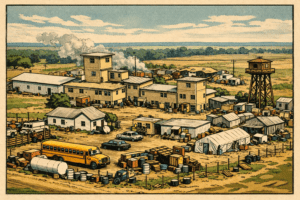
In Jones’s official telling, broadcast in radio messages and presented to visiting outsiders, Jonestown was the realisation of everything Peoples Temple had promised: a self-sufficient agricultural commune of more than a thousand racially integrated American socialists, building a new society in the jungle, free from the racism and capitalism of the country they had left behind. There was a school. There was a medical clinic. There was a central pavilion where Jones preached. Children played. People sang. Visitors who toured the property in 1977 and early 1978 came away with broadly positive impressions, even if some noticed the strain in the smiles and the way everyone seemed to be performing for the visitors.
In the testimony of survivors, the reality was very different. The commune was, in practical terms, a forced labour camp. Members worked in the fields from before dawn until well after dark, on inadequate rations of rice and gravy. They were not permitted to leave. They were subjected to “white nights” — staged emergency drills in which they were told, sometimes for hours at a time, that the camp was under imminent attack by mercenaries or the CIA or the American government and that they must prepare to commit what Jones called “revolutionary suicide.” On at least some of these nights, members were given what they were told was poison and made to drink it. It turned out to be harmless. The exercise was, Jones explained afterward, a loyalty test. The next time, he warned them, would be real.
Jones himself, by 1978, was visibly unwell. He had become heavily addicted to barbiturates, principally pentobarbital, and his speech in recordings from this period is slurred and rambling. He was paranoid in ways that had progressed well beyond the strategic paranoia of his American period into something genuinely delusional. He claimed that mercenaries were closing in on the camp. He claimed that the United States government was planning to send commandos to kidnap the children. He claimed, in increasingly long late-night harangues broadcast over the camp’s loudspeakers, that the only honourable course remaining to his people was to die together rather than be taken.
By autumn 1978, those who could escape were trying to. A group of relatives of Jonestown residents in the United States had organised under the name Concerned Relatives and had been petitioning the State Department, the press, and any politician who would listen to do something about what was happening in Guyana. Their petitions eventually reached the office of Congressman Leo Ryan.
Part Six: Leo Ryan
Leo Ryan was a Democratic congressman from California’s 11th District, representing the area south of San Francisco. He was a politician of unusual personal courage — earlier in his career he had taught undercover in a Watts elementary school after the 1965 riots to understand conditions there, and had once had himself booked into a state prison under an assumed name to see for himself how inmates were treated. When the Concerned Relatives brought him affidavits from former Temple members alleging abuse and false imprisonment at Jonestown, he decided to investigate personally.
Ryan arrived in Guyana on 15 November 1978 accompanied by a small delegation: members of his congressional staff, a small group of journalists including reporters from NBC News and the San Francisco Examiner, and several Concerned Relatives who hoped to extract their family members from the compound. Jones did not want them at Jonestown. After several days of negotiation in Georgetown, the delegation was reluctantly admitted to the camp on 17 November.
The visit, on its face, went better than Ryan might have feared. He toured the facility. He met with Jones, who was visibly impaired but coherent. He attended a performance and meal in the central pavilion at which Jonestown residents put on what was, by every account, a determined display of contentment. The Concerned Relatives in the delegation were reunited with their family members.
Then, late in the evening, a Temple member named Vernon Gosney passed a note to one of the NBC reporters. The note read: Help us get out of Jonestown.
Over the course of the next day, 18 November, more members approached Ryan and his delegation asking to leave with them. By midday, the number was fifteen, and counting. Jones, watching his commune begin to fracture in front of outsiders, became visibly distraught. A Temple member named Don Sly attempted to attack Ryan with a knife — the congressman was uninjured, but the message was clear. Ryan and his party left the camp in the afternoon and drove to the small airstrip at nearby Port Kaituma to depart.
As they were boarding the two small planes that had been sent to collect them, a tractor pulled up to the airstrip carrying armed members of the Peoples Temple security force. They opened fire. Congressman Leo Ryan was killed, along with NBC reporter Don Harris, NBC cameraman Bob Brown, San Francisco Examiner photographer Greg Robinson, and a defector named Patricia Parks. Eleven others were wounded. One of the planes was disabled. The other managed to take off and made it to Georgetown to raise the alarm.
It was the first assassination of a sitting member of the United States Congress in American history. And it was the trigger Jones had been waiting for.
Part Seven: The Revolutionary Suicide
What happened at Jonestown over the next several hours is documented in extraordinary, almost unbearable, detail because Jones ordered the entire event to be recorded. The tape, known to historians as the “death tape,” was recovered from the site by Guyanese officials in the following days and has been transcribed and analysed ever since.
By approximately 5 p.m. on 18 November, with the Ryan party’s plane heading back to Georgetown and the news of the airstrip killings about to break internationally, Jones ordered the residents of Jonestown to assemble in the central pavilion. He told them that the time he had warned them about for years had now arrived. The Congressman was dead. The American government would respond with overwhelming force. The mercenaries he had been describing for years were, he said, in motion. There was, in his telling, only one path that preserved their dignity and their cause: to take their own lives, together, as an act of revolutionary protest.
Some on the tape can be heard arguing. A woman named Christine Miller stands up and argues with Jones for several minutes, asking whether the children at least might be spared, whether there might be any other way. Jones overrides her. Other voices on the tape can be heard shouting her down. Whether out of conviction, exhaustion, fear, or the kind of group dynamic that takes hold when everyone in the room is watching everyone else for the first sign of dissent, the discussion ends.
The killing began with the children. A large stainless steel vat had been prepared containing a mixture of Flavor Aid — a powdered fruit drink similar to Kool-Aid, the brand name that would attach itself permanently to this event — laced with potassium cyanide, chloral hydrate, Valium, and Phenergan. Mothers and nurses, using plastic syringes with the needles removed, squirted the mixture into the mouths of infants. The poison began to take effect within minutes. The smaller children died first.
Then the adults. Some drank from paper cups. Some did so voluntarily and quickly. Some had to be coerced by the armed guards who ringed the pavilion. Some, according to autopsy evidence from the bodies recovered later, appear to have been forcibly injected rather than allowed to drink. The medical examiner who later examined the dead found injection marks on more than seventy bodies, in places where self-injection would have been physically difficult. Whatever Jones’s “revolutionary suicide” was meant to be in his own mind, in practice it included a significant component of murder.
The dying was protracted and visibly painful. Cyanide of the kind used at Jonestown does not produce the quick, peaceful death depicted in fiction. It causes convulsions, vomiting, suffocation. Children who had received the mixture from their parents struggled in their parents’ arms for several minutes before they died. The audio of the death tape, in its later passages, includes the sounds of mass dying.
Jones himself did not drink the poison. He was found later, slumped on the floor of the pavilion, dead of a single gunshot wound to the left temple. Whether he pulled the trigger himself or was shot by someone in his inner circle has never been conclusively determined. His personal nurse, Annie Moore, who was found shot to death nearby and who had written a final note found beside her body, is the most likely candidate if he did not act himself.
When Guyanese soldiers and American officials reached Jonestown the next morning, they found 909 bodies in and around the pavilion. Combined with the four killed at the airstrip and the five who died in the Ryan ambush, the total death toll was 918. Of these, 304 were children under the age of seventeen. The full toll was not initially apparent because many of the smallest bodies lay underneath the larger ones; the first reports from the scene listed fewer than four hundred dead, and the count rose for days as the recovery proceeded.
It remained, for almost twenty-three years, the largest single deliberate loss of American civilian life in modern history. That record was broken on 11 September 2001.
Part Eight: The Survivors
Approximately eighty-seven members of Peoples Temple survived 18 November 1978. Most of these were members who happened to be elsewhere at the time — at the Peoples Temple office in Georgetown, or on errands at the river port at Port Kaituma, or out of the country entirely. A small group escaped from the pavilion during the killings, slipping into the surrounding jungle and walking out over the following days. One elderly woman, Hyacinth Thrash, survived because she had been ill and asleep in her cabin and somehow was not noticed by those bringing the poison around.
A handful of survivors are still alive at the time of writing. Several have given long, careful interviews over the decades since 1978. Some have written memoirs. The historian and former member Laura Johnston Kohl, who died in 2019, became one of the most thoughtful and widely-read voices on what happened at Jonestown and why. Jim Jones Jr, the first Black child the Joneses adopted, survived because he was in Georgetown on the day of the deaths and went on to a long career in business and public speaking. He has been unsparing about his father while also insisting on the genuine idealism that drew many of the Temple members to him in the first place.
That second point is one the survivors have, almost without exception, made repeatedly: the people who died at Jonestown were not stupid, were not contemptible, were not the punchline that American popular culture has frequently made them. They were people, often poor, often Black, often elderly or vulnerable, who had been promised meaningful work in a community that valued them. They were drawn in by what the Peoples Temple offered in its early years, which was real. They were trapped by what it became, which was a coercive and abusive organisation that had taken their passports, their savings, and in many cases their children before it asked them to die. The phrase drinking the Kool-Aid, which has passed into American English as a casual shorthand for foolish credulity, is in this respect a small ongoing injustice to the people it refers to.
Part Nine: The Aftermath
The American response to Jonestown was extensive and somewhat panicked. The Carter administration arranged for the bodies to be flown to Dover Air Force Base in Delaware over the following days — a slow, grim operation complicated by the heat, the jungle, and the sheer number of dead. More than four hundred of the bodies were never claimed by relatives and were eventually buried in a mass grave at Evergreen Cemetery in Oakland, California, where most of the Bay Area Peoples Temple membership had originated. A memorial there, installed in 2008, lists the names of all 918 of the dead. Jones’s name is on it. The decision to include him was controversial and remains so.
The political fallout in San Francisco was immediate and ugly. Mayor George Moscone, who had appointed Jones to the Housing Authority Commission and accepted Temple campaign volunteers, faced sustained questions about what he had known. He never fully answered them. Nine days after the Jonestown deaths, on 27 November 1978, Moscone and city supervisor Harvey Milk were assassinated in their offices at City Hall by former supervisor Dan White, an event unrelated to the Temple but which compounded the sense in San Francisco that the city was coming apart. Several other California politicians who had publicly courted Jones spent years trying to distance themselves from him with limited success.
The broader cultural response was, for a generation, to treat Jonestown as evidence of the inherent dangers of cults. In the late 1970s and early 1980s, an “anti-cult” movement gained significant momentum in American life, with parents hiring “deprogrammers” to forcibly extract their adult children from various religious movements. Books, films, and television specials about Jonestown proliferated. Sociologists and psychologists who studied the case produced a substantial literature on what came to be called the dynamics of high-demand groups — patterns of recruitment, control, isolation, and escalating commitment that Jonestown exemplified and that researchers identified in other movements too.
The simpler interpretation — that Jonestown was the work of a uniquely evil man — is in some ways accurate and in some ways inadequate. Jones was, by the end, a man whose psychological deterioration was visible to anyone in the room with him. But the institution he built had been functioning for two decades before it killed anyone. It had attracted thousands of members, won the public support of significant politicians, and operated openly in the largest cities in California. The interesting and disturbing question is not so much what was wrong with Jim Jones as why the structures around him — civic, journalistic, religious, governmental — took so long to recognise what he had become.
Part Ten: The Names That Matter
918 people died in connection with the events of 18 November 1978. The names that have stayed in public memory are usually those of the perpetrators and the most prominent victims: Jim Jones himself, Congressman Leo Ryan, the NBC journalists Don Harris and Bob Brown, the photographer Greg Robinson. These were public men and they have public legacies.
The others — the 909 who died at Jonestown itself, plus Patricia Parks who was killed trying to leave — are mostly anonymous in the cultural memory of the event. The Jonestown Institute at San Diego State University maintains a full database of the dead, including biographical detail where it is available. Reading through it is instructive in a way that no summary can be. The dead included Christine Miller, who argued with Jones for the lives of the children before she herself was killed. Carolyn Layton, Jones’s longtime lover and one of the architects of the suicide plan, who died believing in what she was doing. Annie Moore, Jones’s nurse, who left a written note before her death that survives as one of the most disturbing primary documents of the event. Hyacinth Thrash’s sister Zipporah Edwards, who did not survive the cabin where Hyacinth did. Edith Roller, a former university professor whose meticulous journals from inside Jonestown are now one of the most important historical sources on what life there was actually like. Marceline Jones, Jim’s wife, who had stayed with him through everything and who was found dead with the others.
The youngest victim was a baby named Jair Alexander Janaro, who was less than a year old. The oldest was a Texas-born woman named Bessie Marie Johnson, who was eighty-eight. A third of the dead were children. They were the first to die because that was Jim Jones’s instruction, and because their parents and the people who had taken responsibility for them did as they were instructed.
A Final Note
The site of Jonestown was abandoned shortly after the Guyanese army completed its recovery operations. The jungle reclaimed it within a few years. Today the clearing is largely overgrown, marked by little more than a few rusted metal structures and the foundation lines of buildings that no longer stand. Some former members and their descendants make occasional pilgrimages there. Most do not.
What lessons Jonestown has to offer are disputed and probably always will be. The cult-studies interpretation focuses on the recruitment and control techniques that Jones used and that recur in other movements; it is useful as far as it goes, though it tends to flatter outsiders by suggesting they themselves would never have fallen for any of it. The political interpretation focuses on the failures of journalism and civic institutions to confront what was visible about the Temple for years before the deaths; this is closer to the bone, but no civic institution exists in a vacuum, and the Temple was, at the time, doing genuine charitable work that its defenders could plausibly point to. The historical interpretation, which is probably the most honest, is that Jonestown was a confluence of several things at once: a damaged man with messianic gifts; a moment in American life that had created a constituency of people genuinely searching for community and meaning; a political establishment willing to overlook a great deal in exchange for organised votes; and a sequence of choices, by many people across many years, that closed off the exits one by one until almost no-one inside could leave.
The people who died at Jonestown have largely been remembered, when they are remembered at all, as a punchline or a cautionary tale. They were neither. They were Americans, mostly poor and mostly Black, who joined a church that promised them a better world and were taken from California to a jungle by a man who lost his grip on whatever decency had once been in him. They deserved better, in life and in memory. The least the rest of us can do is, occasionally, sit with the full number — 918 — and remember that it refers to people.